
Thursday, September 27, 2012
Our blog has moved!
We invite you to visit our blog's new home at www.mcmillandoolittle.com/blog. There you will find our most recent blog on City Target, as well as old favorites from this site. Check out our new website too while you're at it!


Tuesday, June 26, 2012
JCP: The Bloom Already off the Rose?
Back in February, we wrote about the beginnings of the transformation at JCP. it included Fair and Square pricing and the transformation of the stores into town squares with dynamic brand shops. We applauded the effort but also had a number of caveats about how historically hard pricing transformation has been in retail and how underwhelmed we were with the initial creative execution: unclear messaging in-store and in some media outlets.
Fast forward a few months and what we eagerly awaited is now (somewhat) public. Quarterly comp store sales were down an astonishing 18%. The company blamed poor results on the difficulty of transitioning the price strategy (no surprise there) and the poor communication of the messaging (told you so...).
However, we also know that any chance of this turnaround working cannot be measured in quarters--it will take a minimum of 12 months to work through pricing issues and even longer to effectively create meaningful physical and merchandising changes within the stores. So, what does JCP do? Trying to effect these changes while a public company is enormously difficult. JCP's management had significant support at the onset and the stock price was around $42 when we wrote our first blog. Today, it is at half that level.
They acknowledged some communication mistakes and suggested we will see a clearer explanation of the pricing policies (words like sale may re-appear). And in a bit of a stunner, Michael Francis, the President who was brought on from Target to oversee merchandising and marketing, resigned. If anyone reasonably expected a quick turnaround, they really don't understand large scale retail very well.
JCP has aggressively recruited a world class roster of retail talent who will no doubt introduce significant innovation within the brand. The transformation will take time...while clearly WAY too early to judge, it is clear that they are racing the clock, Wall Street confidence and consumer expectations while they attempt to overhaul the brand.
Fast forward a few months and what we eagerly awaited is now (somewhat) public. Quarterly comp store sales were down an astonishing 18%. The company blamed poor results on the difficulty of transitioning the price strategy (no surprise there) and the poor communication of the messaging (told you so...).
However, we also know that any chance of this turnaround working cannot be measured in quarters--it will take a minimum of 12 months to work through pricing issues and even longer to effectively create meaningful physical and merchandising changes within the stores. So, what does JCP do? Trying to effect these changes while a public company is enormously difficult. JCP's management had significant support at the onset and the stock price was around $42 when we wrote our first blog. Today, it is at half that level.
They acknowledged some communication mistakes and suggested we will see a clearer explanation of the pricing policies (words like sale may re-appear). And in a bit of a stunner, Michael Francis, the President who was brought on from Target to oversee merchandising and marketing, resigned. If anyone reasonably expected a quick turnaround, they really don't understand large scale retail very well.
JCP has aggressively recruited a world class roster of retail talent who will no doubt introduce significant innovation within the brand. The transformation will take time...while clearly WAY too early to judge, it is clear that they are racing the clock, Wall Street confidence and consumer expectations while they attempt to overhaul the brand.
Friday, April 20, 2012
Best Buy: The Official Death of Biggest?
Back in 2004, McMillanDoolittle published its landmark book on retail strategy, Winning at Retail. The book describes in great detail the EST model of retailing, which essentially argues that retailers must meaningfully differentiate in at least one area that is critical to the customer. The theory was actually developed far earlier, in the mid-90's, based on empirical studies of successful and non-successful retailers. Our EST's that form the foundation of the model are Cheapest (winning on price), Quickest (winning on location and convenience), Hottest (winning on assortment relevance), Easiest (winning on service and solutions) and Biggest (winning on assortment). While we have internally challenged the model (and had others challenge us back), conceded that it is possible to win with more than one EST, and adapted the model to different industries (slightly different drivers for a services model), it offered an easy to understand and surprisingly solid model of understanding what it takes to win in the retail world: own something in the consumer's mind and build your business practices around delivering that EST.
Unquestionably, the retail world has changed since 2004. The biggest driver of change is the emergence and continued growth of e-commerce. When we were writing Winning at Retail, as an example, Amazon.com's sales were around $5 billion; in 2011, they topped $48 billion and they remain one of the fastest growing companies. E-commerce, while still just around 7% of total retail sales today (and growing at a faster clip than brick and mortar retail), was just under 2% in 2004. The real impact of e-commerce comes in breaking down that general e-commerce number and begin to look at the impact category by category.
Which brings us to Best Buy, subject of countless articles and analysis over the past few weeks. Best Buy has announced a series of store closures as well as the resignation of the CEO. Their struggles have led to speculation that Best Buy might end up with the same fate of some of its historical competitors, companies like Circuit City, Silo, Highland, Fretter, etc...whose name litter the retail graveyards.
While we are not predicting Best Buy's demise (and this is still a $50 billion company--still bigger than Amazon), we do know that their business model requires radical reinvention, and fast. Best Buy's premise of biggest assortments within a physical retail space simply doesn't resonate with customers in the same manner anymore. This core EST principle built around assortment is almost impossible to sustain in a retail setting with the Internet offering nearly infinite selection at the click of a mouse. Other Biggest retailers in our historical model (Borders, Blockbuster, Circuit City) have suffered similar dire results.
When looking at the challenges of Best Buy, it is difficult to know where to begin:
- The digitization of core products (CD's, DVD's) which can be bought or streamed via the web. These products historically drove traffic to the retail stores where customers could then purchase bigger ticket products...
- It is now incredibly easy to price compare on-line. For considered purchase items (TV's, computers) customers are going to take the time to compare (and more times than not, beat the prices of a physical store)
- And while service is important, the drive towards simplification (see the iPad) makes more and more products "plug and play". While service offers like Geek Squad are brilliant, there may (in theory) be less geeks needed if products become easier and more intuitive to use.
We can criticize the quality of the service and other operational issues but the simple point for Best Buy now becomes: the stores are too big and they don't have enough stuff to fill them with. Ancillary categories (musical instruments, fitness equipment, office products) have been introduced but they are not enough to profitably move the needle. And, they can join the long line of retailers who think it would be a good idea to sub-let space.
So? Best Buy is opening Mobile stores more in line with consumer needs and smaller and more efficient to operate. E-commerce sales are growing but still represent less than 6% of total company sales. While that's a nice $3 billion business, 22% of electronics are now sold on-line. Best Buy is way, way behind where they need to be.
What's the fix? Clearly there's not an easy answer. Grow small stores, grow e-commerce but most of all, find a clear reason for the big box retail stores to exist. If Biggest is no longer valid, what is the new EST position that Best Buy can occupy?
Monday, March 5, 2012
Wondering About Wonder!
It comes to us as no wonder (pun intended) that Deerfield, IL children’s behemoth, Wonder!, has shuttered its doors after only three short months. Mothers have discovered ways to become more efficient and are cult-like devotees to sites like diapers.com, thebump.com and babycenter.com for all of their baby needs. The rising popularity of daily deal and member-only sites has also chipped away at brick-and-mortar store sales. As the entire population becomes more tech savvy, it begs the question as to whether or not there is room in the retail landscape for large category killers which can take hours to navigate when customers can simply click and have it delivered the very next day.

Wonder! did have a uniquely curated assortment of the best in everything from strollers to organic baby shampoo and an impressive team of retail minds behind it, yet it seemed to be plagued by its sheer size even before it opened. We originally visited during its opening week and were shocked to observe how few families were present on a nice Sunday afternoon. While it is a given that it would take hundreds of people to make the store seem full, it was incredibly sparse with only a child running by us every now and then. Also sparse were the corners of the store which were left empty as an early indicator of financial trouble to fill the warehouse-size space. By chance we visited again the Friday before Wonder! announced it was closing and noticed a few changes. Most notably, were the yellow sale tags offering 50% off dotting the store and massed out merchandise to fill the empty spaces. This is a strategy to make the space seem fuller, yet it is just more of the same item.

The team at Wonder! seems optimistic about reopening the store once it works out its balance sheet and merchandise availability difficulties. We at McMillan Doolittle would recommend that they be overly cautious and assess the relevance of a store of this size in such a fragmented retail world.
Wednesday, February 29, 2012
Jason Wu
As loyal Target customers, the launch of Jason Wu at Target had been highlighted on our calendars for months with us anxiously anticipating its arrival. Still on a high from the fabulous pieces from the Missoni for Target collection, we arrived on February 5th at 6:50am for the 8am store opening. Needless to say, we were not the only ones with this idea. With an hour and 10 minutes still remaining until the doors opened, there was already a line of 15 people – and not all women! Both men in front of and behind us were in line sans wives in hopes of scoring the perfect Valentine’s Day gift. While waiting in line, we overheard many women mapping out which pieces that they were going after first after studying look books online. At about 7:45am a Target security guard on a Segway addressed the crowd of 150+ eager Jason Wu fans with a message about safety. Like a grade school teacher, he asked us to walk not run and be nice mature adults. This little pep talk did little to curb fashionistas at the front of the line who did their best speed walk/run to women’s apparel when the doors finally opened.
Once the crowds were let in at increments of 100, it was as if the rule book had been thrown out the window. Within seconds the racks were clean with clothing strewn on the floor, leaving only the larger sizes as remnants of what took months of planning and collaborating to create. I was stealth enough to grab the three pieces that I had my heart set on and quickly made my way to the fitting rooms. To say that the pieces were a disappointment would be an understatement. The cute fluffy yellow shirt that I saw online looked more Big Bird than a chic top made by an “it” designer. The adorable stripped pale pink and navy dress that I couldn’t wait to see in person was so poorly constructed and matronly. I had a third piece that I didn’t even bother trying on since I was so disappointed in the quality and styling. When I left the dressing room, it seemed that everyone else had the same reaction as I did. The fitting room attendants had their hands full hanging up the rejects to send back to the floor. This made the entire experience even more frustrating – waking up at 6am on a Sunday when I could have come in by 9am and seen the entire collection since so little was actually being brought to the register. To make the bus trip to Target not a total waste, I picked up solid black and white tank tops and nail polish. Needless to say, I would have much rather picked up these basics at a more reasonable hour on Sunday.
After making the trek back home, I proceeded to call my Mom and girlfriends to tell them to stay in bed and wait for the next designer collaboration. We can only hope that the Shops at Target will deliver and stay true to the upscale stores that they are trying to emulate.
Once the crowds were let in at increments of 100, it was as if the rule book had been thrown out the window. Within seconds the racks were clean with clothing strewn on the floor, leaving only the larger sizes as remnants of what took months of planning and collaborating to create. I was stealth enough to grab the three pieces that I had my heart set on and quickly made my way to the fitting rooms. To say that the pieces were a disappointment would be an understatement. The cute fluffy yellow shirt that I saw online looked more Big Bird than a chic top made by an “it” designer. The adorable stripped pale pink and navy dress that I couldn’t wait to see in person was so poorly constructed and matronly. I had a third piece that I didn’t even bother trying on since I was so disappointed in the quality and styling. When I left the dressing room, it seemed that everyone else had the same reaction as I did. The fitting room attendants had their hands full hanging up the rejects to send back to the floor. This made the entire experience even more frustrating – waking up at 6am on a Sunday when I could have come in by 9am and seen the entire collection since so little was actually being brought to the register. To make the bus trip to Target not a total waste, I picked up solid black and white tank tops and nail polish. Needless to say, I would have much rather picked up these basics at a more reasonable hour on Sunday.
After making the trek back home, I proceeded to call my Mom and girlfriends to tell them to stay in bed and wait for the next designer collaboration. We can only hope that the Shops at Target will deliver and stay true to the upscale stores that they are trying to emulate.
Monday, February 6, 2012
JC Penney's Dramatic Transformation Begins

If you pay any attention at all to the retail scene, it would have been hard to miss the news of JCP's announced transformation. It has garnered significant buzz with its new management team led by Ron Johnson, Apple store's former retail guru and a star-studded cast recruited from Target and others.
The transformation has three main components:
--A "simplified" everyday low price strategy with a few twists, called fair and square
--A new logo (above)
--Planned dramatic changes to the retail environment, with 80-100 well defined shops within shops and a Town Square component
While it will take a fairly long time to create dramatic change within the stores, the new marketing strategy can be seen now, in circulars as well as TV spots...
From the very basic standpoint of marketing, it is already working. We flipped through the JCP Sunday circular, which is the first time we can say that in quite some time. The ads, highly reminiscent of Target in style, begin to demonstrate the new pricing strategy's three elements:
--Simplified everyday prices, all ending in $ price point ($16, $20, etc)--In Red
--A monthly price, which is presumably a savings from the everyday price--In White
--Mark down prices (Best Prices) which will be in store the 1st and 3rd Friday in February--In Blue
The first time through, this seems extremely confusing. It was difficult to understand what a "February" price really is and the everyday prices are difficult to gauge without clear comparisons (most of the promoted items are private label). And, of course, we don't know how great the mark down deals will be (how many, how deep, etc...). The circular format itself is clean and refreshing and a definite breath of fresh air.
In the extraordinarily annoying TV commercial(don't say you weren't warned): http://www.youtube.com/watch?feature=endscreen&NR=1&v=uI42p6j4yNA, customers rebel against the craziness of multiple pricing strategies, markdowns and clearances. Note: there are much better versions that play off the same theme elsewhere on YouTube.
Simplification of retail pricing in much of the department store channel is desperately needed but has also been historically difficult to achieve for those who have gone down the path before.
Of course, the real test will be the experience once customers get to the store--the transformation in JCP's 1100 stores will be a longer and more expensive process. It will also be an eagerly awaited test to see if simplification can be extended to stores as complex as JC Penney.
We admire the boldness of vision and no doubt JC Penney will be monopolizing retail headlines for some time as their initiatives play out.
As we have always remarked, the great thing about retail is its immediacy: JCP's stock had a very nice run up after the announced new strategy. We'll know fairly quickly if customers beat a similar path to their doors.
Post Script. Had a chance to visit a JCP the other day while on the road. The new pricing policy is in full effect, with every item re-stickered to reflect the new pricing strategy. Some of the everyday pricing seems incredibly sharp--$5 super absorbent bath towels and the like which should certainly grab the customers' attention. They weren't kidding on markdowns either. Blue tagged items took items that were already marked down about 70% and reduced them 20-30% further...
The big miss? Not a scrap of signing explaining the new program to customers, which could have easily been accomplished by replicating the very clear explanations evident in the print ads. And, the intent and purpose of month specials (February specials, in magenta, of course) is not terribly evident in store.
Monday, October 24, 2011
"Made for All" - our visit to the new Fifth Avenue NYC Uniqlo
Japan’s basic apparel category killer store Uniqlo opened its 89,000 square foot (bigger than a football field!) Fifth Avenue/53rd St. location (second of three planned New York City locations) on October 14, 2011. We had the opportunity visit this store during a short 20-hour jaunt to the Big Apple.
By nature of our flight’s arrival time into the city in the late evening, we had the good fortune of experiencing the store during an off period – about half hour before closing. The store was certainly less chaotic at this time during the day – we attempted to go the next evening as well but quickly exited the can-of-sardines environment.
From across the street, the store exudes an Apple Store-esque glass cubic glamour. Fully-functioning elevators are closed off to the public and instead display a mannequin couple, riding up and down in the front windows to the delight of passersby.

It’s easy to forget that you are in a clothing store– with the clean, stark open format, the store has the same look and as Narita airport, complete with three long escalators in the center of the store and a cool, soothing female voice over the loudspeaker welcoming you to Uniqlo and announcing what products are on each floor.


The store does a beautiful job of “layers” of communication on the merino cotton apparel and the brand’s new “Heat-Tech” line:
 |
| Large block letters catch the customer's eye by indicating what material line the product is from - "100% Extra Fine Merino" |
 |
| Second board gives information about the premium quality of the merino material. |
 |
| Smaller sign as you look closer at the product -- indicates the style, and a more detailed description of the style. |

 |
| Eye-catching hallway draws customer in |
 |
| Boards on top of product racks educate and encourage shoppers to buy other products from the same line. |

The store makes good use of brightly lit floor-to-ceiling LED screens to feature their products as well as Uniqlo brand ambassadors. The screens were not interactive, but this may have been deliberate, as shoppers seemed more intent on stuffing their bags with as much Uniqlo product as possible rather than admiring the surrounding décor.

 |
| Several walls are completely paneled with LED screens, giving shoppers styling ideas |
The store is somewhat confusing in terms of layout, but there are maps on the walls and the aforementioned loudspeaker message. On the main floor, the layout is maze-like and designed for the quick-paced wanderer. There are specific areas on the mezzanine floor for people to sit, conveniently out of the way of shoppers – genius.

 |
| Seating area for tired shoppers and shoppers' mates, conveniently out of the way. |
Uniqlo’s impressive displays are essentially the apparel version of Whole Food’s produce section. The merchandise is neatly stacked, hung, and folded in wall shelving, displaying Uniqlo’s extensive range of color options in each style.
 |
| Category killing in basics - like basic t-shirts. |
 |
| More category killing in basics. |
 |
| Take one product/material and do it well...in every color! |
Checkout is stress-free single-line Whole Foods –style. Interesting to note: when checking out, staff members have a scripted response: “Your total is $X for X# of items.” – perhaps to emphasize how much bang you’re getting for your buck?

Overall, Uniqlo gives off a very clear message that certainly seemed to resonate with consumers – there was no rhyme or reason to the demographic in the store, and the melting pot of people epitomized Uniqlo’s tagline (which is currently plastered all over New York City public transit and billboards) “Made for All”.

It was certainly made for us, that’s for sure. We actually had to purchase another bag to haul back our Uniqlo treasures…
Friday, September 30, 2011
Report from WRC--A Global Perspective on Global Innovation


We had the pleasure of attending the World Retail Congress in Berlin, which was held from September 25-28th of 2011. The World Retail Congress is a gathering of international retail executives. While there is a decidedly European feel to the conference (and attendees), North America and Asia was reasonably represented.
Ebeltoft’s (and our) official role at WRC was a coordinator and judge in this year’s Retail Innovation awards as the US member of Ebeltoft Group. This year, a record number of nominations were submitted and categories were split into two categories—business innovation (more about process) and format innovation (more about format).
The finalists provide a telling view on where Innovation is headed. In the format innovation category, they were:
• American Eagle –77 Kids. Their new concept store incorporates innovative digital in-store experiences with a dynamic in-store design
• Carrefour Planet. The most significant reinvention project in retailing. An attempt to reinvent the generalist hypermarket concept into a multi-specialist store
• Disney Store—New York. The largest Disney Store , representing their large scale reinvention, incorporating immersive interactive experiences
• Shoes of Prey—Australia. The only pure play on-line retailer, where customers can customize and design their own shoes, changing the color, toe, heel type, back etc.
• Eataly—New York. The fantastic New York outpost of the Italian food concept, blending together restaurant and food retail in a dynamic experience.
• The Craftsman Experience. Built as both a store and studio, this concept re-defines the relationship between a bricks and mortar store, the Internet and social media.
The winner in this category, Eataly, proves that retail excitement can still drive significant traffic to a brick and mortar store. Eataly reports first year revenue of an eye-popping $80 million.
Under business innovation, the range of submissions were vast, from weather forecasting tools to the latest take on loyalty marketing. The finalists were:
• Donna Ida—Denim Clinic. One-to one appointments to find the perfect pair of jeans.
• Karen Millen and Aurora Fashions—Deliver from 90 minutes. The world’s fastest fashion on-line delivery service
• Payvment—Facebook Storefront. The number one Facebook ecommerce payment platform for more than 800 million Facebook users.
• Titan Industries Goldplus—A soft benefits loyalty program for a jewelry chain in India, which rewards customers in the form of life experiences (a Cricket Match, trip to a Temple, etc
• Adidas—adiVERSE Virtual Footwear Wall. An in-store virtual footwear wall for Adidas utilizing state of the art Intel processors and touch screen technology.
• Tommy Hilfiger Europe—The Hilfiger Club +ID24. Interactive touch screens at POS to drive higher loyalty.
The winner here was Adidas, who also had their wall on display at the WRC. They plan on introducing this into a physical store environment within their London Flagship store.
What do these concepts have in common?:
• The seamless (or attempt to make seamless) integration of new technologies
• Blending together on-line and off-line experiences
• Creating more personalized and customer experiences, whether through the customization of products or the customization of experience.
In addition to the cases highlighted at WRC, Ebeltoft Group produces an independent project focusing on additional cases from around the world that showcases true global innovation. Contact me at nstern@mdretail.com to reserve a copy.
Monday, September 19, 2011
Loyal Until The First Screw-Up
Like many, we received an e-mail from Netflix CEO Reed Hastings this morning concerning the controversy surrounding their sudden price increase (upwards of 60% in many cases, including ours) a few months back. In addition to suddenly increasing prices, there seemed to be zero recognition of customer loyalty. When we cancelled the “by mail” portion of our subscription, the response was an automated statement requesting that the outstanding DVD’s be returned immediately or we would be charged the full price, etc… Nice knowing you, Netflix.
Apparently, we weren’t alone. The latest results from Netflix reveal a rash of subscriber cancellations, with subscriber base declining by nearly a million. This is even more startling because the company was on a significant growth trajectory prior to this move. The streaming side has also faced its own issues of late, losing its contract with Starz, a popular source of streaming content. The stock, predictably, has plummeted from its earlier dizzying highs. And yet, two months went by without a direct response to the million(!) customers who apparently were unhappy.
So what did Reed have to say to customers today? Along with a brief apology, a more detailed explanation of the “business” problem emerges. Internally at Netflix, streaming and by mail businesses need to be nurtured and grown separately. As a result, they are officially separating the two models, even renaming the original business to Quikster. Customers who subscribe to both will now get two invoices and visit two separate websites. But, the good news—no more price increases for the added inconvenience!
While Reed Hastings has been one of the more dynamic executives of the Internet age, we suspect that this second explanation isn’t going to play much better than the first. The consumer moved from a bundled (and intuitive) solution to a separated one. We would suspect that more customers will opt out of one (or both) services and that it will be much easier to view their offers independently against other options. Two months in and can’t saw we’re missing the by-mail service and the streaming option often disappoints with limited or dated content.
While the intent of aggressively positioning the business for a streaming future so his business doesn’t become the next AOL or Borders is an admirable one, the execution of this plan has consistently lacked thoughtfulness and most importantly, a focus on the customer that Netflix (or Quickster) is supposedly serving.
So, apology not accepted. And for businesses that pride themselves on delivering customer service, the caveat in the headline applies: customers are only loyal until you give them a reason not to be.
Apparently, we weren’t alone. The latest results from Netflix reveal a rash of subscriber cancellations, with subscriber base declining by nearly a million. This is even more startling because the company was on a significant growth trajectory prior to this move. The streaming side has also faced its own issues of late, losing its contract with Starz, a popular source of streaming content. The stock, predictably, has plummeted from its earlier dizzying highs. And yet, two months went by without a direct response to the million(!) customers who apparently were unhappy.
So what did Reed have to say to customers today? Along with a brief apology, a more detailed explanation of the “business” problem emerges. Internally at Netflix, streaming and by mail businesses need to be nurtured and grown separately. As a result, they are officially separating the two models, even renaming the original business to Quikster. Customers who subscribe to both will now get two invoices and visit two separate websites. But, the good news—no more price increases for the added inconvenience!
While Reed Hastings has been one of the more dynamic executives of the Internet age, we suspect that this second explanation isn’t going to play much better than the first. The consumer moved from a bundled (and intuitive) solution to a separated one. We would suspect that more customers will opt out of one (or both) services and that it will be much easier to view their offers independently against other options. Two months in and can’t saw we’re missing the by-mail service and the streaming option often disappoints with limited or dated content.
While the intent of aggressively positioning the business for a streaming future so his business doesn’t become the next AOL or Borders is an admirable one, the execution of this plan has consistently lacked thoughtfulness and most importantly, a focus on the customer that Netflix (or Quickster) is supposedly serving.
So, apology not accepted. And for businesses that pride themselves on delivering customer service, the caveat in the headline applies: customers are only loyal until you give them a reason not to be.
Wednesday, July 13, 2011
Diapers Direct and the Perils of Groupon
“We sincerely apologize about the delay on your product delivery.” These are not the words that you want to see when you open your email, particularly with something as essential as diapers. At the beginning of June, we purchased a $25 Groupon for $50 worth of product from diapersdirect.com. We promptly placed our order (as many others did as well), and received our diapers in mid-June. Apparently, we were one of the lucky ones, as we discovered that this was the fourth email that Groupon customers had received regarding unfulfilled orders. So, we did a little digging and this is what we found:
• A quick Google search indicates that Diapers Direct offered a Groupon in Amarillo on May 11 which was purchased by 1,396 Groupon-ers. Over the course of the next 3 ½ weeks, this deal was featured in at least five other cities and purchased by over 900 additional customers. As we read the email mentioned above further, Diapers Direct goes on to state, “An estimated 98% of Groupon customers at our website have used their coupon within one day of purchasing it. The steady stream of customers over a six month period that we had planned for became a tidal wave of orders all made in the past thirty days.” Recent data from Groupon is consistent, with only 10% redeeming their coupon within one month, but if nearly 1,400 orders were placed on day one, this leaves us scratching our heads as to why Diapers Direct didn’t pull the deal after the first tidal wave of orders.
• Diapers Direct is a small business (with only 3 employees, according to their email) that presumably used Groupon in order to get a couple hundred new customers. “We have had commercial customers that purchased as many as 110 Groupon coupons.” Unfortunately, they didn’t set a limit on how many people could purchase their coupon and they instantly became overwhelmed.
• In a recent study on daily deal sites conducted by Rice University, nearly 80% of coupon users are first-timers, and only 20% of them become repeat customers. This conversion rate does not bode well for Diapers Direct (particularly since so many customers still have open orders). “We are by nature a recurring order company. A company designed to make monthly deliveries to a regular repeat customer base.” We’re betting the commercial customers mentioned above were not planning to become repeat customers. What’s more, any pre-existing customers are likely having a difficult time placing non-Groupon orders, damaging their existing customer base.
So what are the lessons learned?
• Know how Groupon works. Understand everything from what percentage Groupon will take of your profit, how many coupons the deal is limited to and how many coupons are available to purchase for each customer.
• Ensure your business can cover the discount you will offer. Diapers Direct planned to “lose a little money on every transaction and expected to do so as this was our way of introducing ourselves to all of you.” They likely did not plan for as many transactions as they got.
• Plan for best and worst case scenarios. Can you accommodate 1,000 new customers? Have you ordered additional stock for the initial wave of orders and the final month of your deal as customers try to use their soon-to-expire Groupons? Do you have enough staff to accommodate the influx of orders? Even if Diapers Direct had all product in stock, three employees could not efficiently and effectively fill all orders in a timely manner.
Groupon is bigger and more powerful than most of us understand. It’s either a quick way to double your sales or to go out of business.
There’s no question that Groupon, Living Social and the myriad of competitors are nothing short of a global phenomenon in retailing, service and foodservice businesses over the past two years or so. It is equally clear that there is much that’s unknown about these offers, particularly as it relates to both short and long-term success. We know the old saying Caveat Emptor (buyer beware!). In this instance, Caveat Venditor (seller beware!).
This is a guest blog from Felicia Greenbaum, McMillanDoolittle Business Manager
• A quick Google search indicates that Diapers Direct offered a Groupon in Amarillo on May 11 which was purchased by 1,396 Groupon-ers. Over the course of the next 3 ½ weeks, this deal was featured in at least five other cities and purchased by over 900 additional customers. As we read the email mentioned above further, Diapers Direct goes on to state, “An estimated 98% of Groupon customers at our website have used their coupon within one day of purchasing it. The steady stream of customers over a six month period that we had planned for became a tidal wave of orders all made in the past thirty days.” Recent data from Groupon is consistent, with only 10% redeeming their coupon within one month, but if nearly 1,400 orders were placed on day one, this leaves us scratching our heads as to why Diapers Direct didn’t pull the deal after the first tidal wave of orders.
• Diapers Direct is a small business (with only 3 employees, according to their email) that presumably used Groupon in order to get a couple hundred new customers. “We have had commercial customers that purchased as many as 110 Groupon coupons.” Unfortunately, they didn’t set a limit on how many people could purchase their coupon and they instantly became overwhelmed.
• In a recent study on daily deal sites conducted by Rice University, nearly 80% of coupon users are first-timers, and only 20% of them become repeat customers. This conversion rate does not bode well for Diapers Direct (particularly since so many customers still have open orders). “We are by nature a recurring order company. A company designed to make monthly deliveries to a regular repeat customer base.” We’re betting the commercial customers mentioned above were not planning to become repeat customers. What’s more, any pre-existing customers are likely having a difficult time placing non-Groupon orders, damaging their existing customer base.
So what are the lessons learned?
• Know how Groupon works. Understand everything from what percentage Groupon will take of your profit, how many coupons the deal is limited to and how many coupons are available to purchase for each customer.
• Ensure your business can cover the discount you will offer. Diapers Direct planned to “lose a little money on every transaction and expected to do so as this was our way of introducing ourselves to all of you.” They likely did not plan for as many transactions as they got.
• Plan for best and worst case scenarios. Can you accommodate 1,000 new customers? Have you ordered additional stock for the initial wave of orders and the final month of your deal as customers try to use their soon-to-expire Groupons? Do you have enough staff to accommodate the influx of orders? Even if Diapers Direct had all product in stock, three employees could not efficiently and effectively fill all orders in a timely manner.
Groupon is bigger and more powerful than most of us understand. It’s either a quick way to double your sales or to go out of business.
There’s no question that Groupon, Living Social and the myriad of competitors are nothing short of a global phenomenon in retailing, service and foodservice businesses over the past two years or so. It is equally clear that there is much that’s unknown about these offers, particularly as it relates to both short and long-term success. We know the old saying Caveat Emptor (buyer beware!). In this instance, Caveat Venditor (seller beware!).
This is a guest blog from Felicia Greenbaum, McMillanDoolittle Business Manager
Monday, July 11, 2011
Bloomingdales.com--The devil is (apparently lost) in the details
It is wonderful to see how well Macy's Inc. (parent of Bloomingdales) has been doing of late. They are in their second year of comp store increases and they do seem to have the company heading in the right direction. In their last press release, they also made note that their e-commerce division is performing even better--up a spectacular 40% year to year.
As a retail consultant, we tend to live in the kind of numbers above. As a customer, things tend to be a little different. We recently bought some California King sheets during a great sale at Bloomingdales...good item, great price, etc...
When the sheets arrived (in a horribly oversized box with no padding, by the way), they were not the "latte" clor we wanted but a very lovely purple. This is despite the fact that the bar code tag said latte...oops.
So, now what?
1. Called our local store who nicely explained that they don't sell Cal Kings in Chicago but we could try and call a California store...
2. Returned the item (at our expense) and explained they got the color wrong
3. A few weeks later, the replacement comes...and yes, still purple! Two observations--they clearly mis-tagged the product and; there is no human checkpoint to distinguish between latte and purple..
4. Return the sheets to a local store and (again) explain the problem. Their advice? Wait about 30 days before ordering again and HOPEFULLY, they will have figured out the whole latte/purple mix up by then
5. Receive a Bloomie's gift card (no credit refund) for an amount that is less the cost of the original shipping, return shipping, etc
6. Bottom line--no sheets, an enormous hassle and out money
What's wrong with this picture? It's almost impossible to figure out where to begin--failures in process, quality control, customer service, and so on.
It's nice to hear that on-line sales are up 40% but how will they be able to position themselves in the long run against a growing number of competitors who have figured this stuff out?
As a retail consultant, we tend to live in the kind of numbers above. As a customer, things tend to be a little different. We recently bought some California King sheets during a great sale at Bloomingdales...good item, great price, etc...
When the sheets arrived (in a horribly oversized box with no padding, by the way), they were not the "latte" clor we wanted but a very lovely purple. This is despite the fact that the bar code tag said latte...oops.
So, now what?
1. Called our local store who nicely explained that they don't sell Cal Kings in Chicago but we could try and call a California store...
2. Returned the item (at our expense) and explained they got the color wrong
3. A few weeks later, the replacement comes...and yes, still purple! Two observations--they clearly mis-tagged the product and; there is no human checkpoint to distinguish between latte and purple..
4. Return the sheets to a local store and (again) explain the problem. Their advice? Wait about 30 days before ordering again and HOPEFULLY, they will have figured out the whole latte/purple mix up by then
5. Receive a Bloomie's gift card (no credit refund) for an amount that is less the cost of the original shipping, return shipping, etc
6. Bottom line--no sheets, an enormous hassle and out money
What's wrong with this picture? It's almost impossible to figure out where to begin--failures in process, quality control, customer service, and so on.
It's nice to hear that on-line sales are up 40% but how will they be able to position themselves in the long run against a growing number of competitors who have figured this stuff out?
Thursday, May 19, 2011
Apple: A Decade of Retail Revolution

On May 19, 2001, the first Apple stores opened (more or less simultaneously) in Tysons Corner, Virginia and the Glendale Galleria. While the stores were eagerly awaited, they were also greeted with some understandable skepticism. Gateway had notably flamed out in retail, having to close all of their stores and Sony had been flip-flopping with a retail strategy during this same time period as well.
One of our favorite quotes on Apple’s retail strategy comes from a story headlined: Sorry Steve, Here’s Why Retail Stores Won’t Work. The story explains in some detail why getting into retail is a bad idea and ends with a quote from David A. Goldstein, who states, "I give them two years before they're turning out the lights on a very painful and expensive mistake".
Unfortunately, for us, David had some company. In our Retail Watch newsletter from July of 2001, we extol on the virtues of how cool the stores, saying “it helps that Apple’s stuff is cool itself—their product design is second to none and showcased within this amazing new environment”. Unfortunately, we also go on to say, “It will be very hard to ever make any money”. Oops.
So, how are the Apple stores doing? Well, we were only a few billion dollars off when assessing future profitability! In fact, the stores are obscenely profitable—300 stores Internationally, and over $2 billion in profits on $9 billion in sales. More to the point, they are one of the few branded retail stores (Nike and Coach join the ranks) that succeed in both elevating the image of the overall brand while delivering high levels of profitability.
Other numbers are equally astounding:
• Sales per square foot, a key measure in a retailer’s productivity, are estimated at around $5,000 per square foot! No one else in retail even comes close.
• Traffic counts are equally amazing, particularly in such a condensed space. Apple is averaging 15,000 customers per week in their stores, which is extraordinary given the compact store size.
Now, since we owned up to a “slightly” off prediction on Apple’s retail prospects, we also want to point out that it is a radically different company today than in 2001 (here comes the mea culpa):
• In 2001, Apple was a relatively small computer seller with a 3% market share. We still maintain that those margins on computers and the relative difficulty of the computer sales cycle does make selling "computers" profitably a daunting experience. Apple was “only” a $5 billion company back in 2001.
• Apple is now a huge consumer products retailer. Selling iPods, iTouches, iPhones and the like, in droves, is a very efficient retail proposition, accompanied by higher (and controlled) margins. The relative levels of profitability (and overall revenues) sky-rocketed once this shift took place. For history’s sake, the first iPod debuted in October of 2001 while the country was pre-occupied with post 9/11 matters. In 2011, Apple could well hit $100 billion in total revenues. Wow!
So, it becomes a classic "chicken and egg" dilemma. Could have Apple ever been a successful retailer without the dramatic introduction of game changing products like the iPOd? Conversely, would those products ever had a chance to shine without dedicated retail distribution?
The flipside of Apple’s retail success is that it has encouraged a number of other companies to follow suit. Few, if any (though we’re careful NOW not to make sweeping predictions) will ever come close to reaching Apple’s success: A rare combination of brand, product and an extraordinary retail experience came together to forge this remarkable game-changing retail story. Most companies will find themselves lacking in one or all of these areas.
There are rumors that version 2.0 of Apple retail is on the way. We can't wait.
Thursday, May 12, 2011
Who Moved My Chipotle?

In my hometown of LaGrange, Illinois, something curious has happened. The (and one can only presume based on dozens of visits) fabulously successful Chipotle branch in the heart of our downtown moved…approximately three blocks away. Now while this would not seem to be of particular consequence, there are some extenuating circumstances behind the move:
• It moved to the “other” side of the tracks. While the original location was directly across from the commuter train stop, the new location is a block or so North, at the intersection of the two busiest roads in town.
• It moved, very ironically, into a recently closed Baja Fresh location. Yes, it was pre-wired for burritos but the next logical question follows…why exactly did this Baja close?
• It moved to a location with parking, though shared with Walgreens, Caribou and an AT&T store. The parking is certainly a plus over the sometimes “impossible to find a space” downtown location.
So, you ask—what’s the problem? They stayed in the hood and added parking. Let’s examine the other side of the ledger:
• The new location feels (and almost certainly is) smaller. Seating only is for around 50 (at best). Worse, there is no separation between the seats and the line so there is a decidedly uncomfortable feel while queuing or eating. While we have been in tighter Chipotle spaces, the old space (long, with high, exposed ceilings and real character) had a significantly more pleasant feel and atmosphere.
• The old Chipotle was incredibly popular with the teenage crowd. Along with Starbucks a block or so away, it was the de facto hangout in town. Who wants teens hanging around? As long as those teens have money (which the La Grangian version most certainly do), why not. This location is not nearly as central to the walking crowd which is a significant part of downtown traffic, particularly during the (admittedly rare) nice days of Chicago.
In all, a curious move. Could the addition of parking trump all of the other negatives? Was the landlord simply impossible to deal with? We’ll find out. We suspect that business will be down but maybe Chipotle’s magic trumps even a bad real estate play. While we are huge fans of Chipotle, we are once again reminded that all retail is local--while they are winning big time on a national scale, this might be a local loss.
Tuesday, March 22, 2011
China: Enormous Opportunity, Enormously Difficult
We just finished up a week of meetings and store visits in China. The amount of information we now have on the market could fill a thimble—a few trips hardly qualifies one as an expert. Of course, that won’t stop us, so here goes.
The statistics, as we have discussed before, boggle the mind. A population of 1.3 billion people, a rising economy and over 250 cities with more than a million people presents opportunities at nearly every turn. What could possibly go wrong for companies who are positioning themselves to do business in what will easily be the world’s largest economy in the not too distant future? Plenty, as it turns out.
During the week of our visit, two unrelated news stories caught our attention. The first is Best Buy’s decision to close their nine branded stores in China. While they will still have an investment in a Chinese electronics retailer, Five Star, closing their eponymous brand feels like an early signal of defeat. Observationally, the Chinese market for appliances and electronics looks and feels very different than the U.S. Price dominates and the stores are loud and noisy, populated by brand supplied salespeople in an environment where negotiation is expected. Gome, the large Chinese retailer, currently dominates. Best Buy, with an elevated customer experience, was way out ahead of the curve.
The complementary story of the quiet closing of the six story House of Barbie flagship store in Shanghai was even more surprising. This much written about experiential store was the global equivalent of American Girl and had just opened in 2009. The costs to operate, and/or the costs to close both had to have been substantial. This is a store that was more a brand builder than a money maker, even at the outset. It must have been losing even more money than even planned to pull the plug this early. Since Barbie’s owner, Mattel, is not a retailer, we would suspect some significant miscalculations on their part in what it takes to operate a Flagship retail store.
Home Depot is also in retreat, closing the Beijing outlets acquired when they purchased local retailer Home Way. To be equal opportunity with International struggles, the French DIY chain Saint-Gobain is also pulling out of the China market. The DIY market in China is far less developed, as apartments tend to come fully equipped.
The China market is large (and growing at incredible rates) but is also intensely competitive. Local regulations further hamper foreign businesses and bodies in the store (of which there are lots) don’t always translate into high sales. Average transaction size and sales density are quite low (in most cases) for now. The market is “open” but you’re never very far from remembering that this is a Communist country tightly controlled by the government. We couldn’t access our Blog page in China—censored (apparently) by the government!
This is definitely a market where investing for the future is required—quick returns are likely not there. Exceptions include a booming luxury goods market and a preponderance of very successful (think KFC) fast feeders. As the large global retailers (Auchan, Tesco, Carrefour, Walmart) battle it out, China will be a fascinating retail landscape to watch over the next decade. It decidedly is not, however, for the faint of heart.
The statistics, as we have discussed before, boggle the mind. A population of 1.3 billion people, a rising economy and over 250 cities with more than a million people presents opportunities at nearly every turn. What could possibly go wrong for companies who are positioning themselves to do business in what will easily be the world’s largest economy in the not too distant future? Plenty, as it turns out.
During the week of our visit, two unrelated news stories caught our attention. The first is Best Buy’s decision to close their nine branded stores in China. While they will still have an investment in a Chinese electronics retailer, Five Star, closing their eponymous brand feels like an early signal of defeat. Observationally, the Chinese market for appliances and electronics looks and feels very different than the U.S. Price dominates and the stores are loud and noisy, populated by brand supplied salespeople in an environment where negotiation is expected. Gome, the large Chinese retailer, currently dominates. Best Buy, with an elevated customer experience, was way out ahead of the curve.
The complementary story of the quiet closing of the six story House of Barbie flagship store in Shanghai was even more surprising. This much written about experiential store was the global equivalent of American Girl and had just opened in 2009. The costs to operate, and/or the costs to close both had to have been substantial. This is a store that was more a brand builder than a money maker, even at the outset. It must have been losing even more money than even planned to pull the plug this early. Since Barbie’s owner, Mattel, is not a retailer, we would suspect some significant miscalculations on their part in what it takes to operate a Flagship retail store.
Home Depot is also in retreat, closing the Beijing outlets acquired when they purchased local retailer Home Way. To be equal opportunity with International struggles, the French DIY chain Saint-Gobain is also pulling out of the China market. The DIY market in China is far less developed, as apartments tend to come fully equipped.
The China market is large (and growing at incredible rates) but is also intensely competitive. Local regulations further hamper foreign businesses and bodies in the store (of which there are lots) don’t always translate into high sales. Average transaction size and sales density are quite low (in most cases) for now. The market is “open” but you’re never very far from remembering that this is a Communist country tightly controlled by the government. We couldn’t access our Blog page in China—censored (apparently) by the government!
This is definitely a market where investing for the future is required—quick returns are likely not there. Exceptions include a booming luxury goods market and a preponderance of very successful (think KFC) fast feeders. As the large global retailers (Auchan, Tesco, Carrefour, Walmart) battle it out, China will be a fascinating retail landscape to watch over the next decade. It decidedly is not, however, for the faint of heart.
Monday, February 21, 2011
Ano"Mall"ies--Three Great Shopping Centers

Santa Monica Place
One of the side benefits of the massive winter storm we had a few weeks back was getting "stranded' in Los Angeles and London. While "idle hands may be the devil's tools", at McMillanDoolittle that just means more time to go and visit stores.
And while we are always fascinated with new retail concepts and stores, the malls that they are housed in have become so increasingly vanilla that they hardly merit a look. The story in the shopping center industry is the same as many others--consolidation, scale, efficiency=blandness.
There are exceptions to the rule and we visited three amazing centers (separated by a lot of geography) more or less back to back to back. The Grove and Santa Monica Place are two bright spots in Southern California and the Westfield Center in Shepherd's Bush in London represents an extraordinary shopping center achievement.

Desigual--The hot Spanish retailer at Westfield
When trying to distill common elements from these very different properties, we summarize a few of the key elements as follows:
Great Stores. This should go without saying but the hallmark of a great shopping center begins with the tenant mix. The old formula for a shopping center would consist of three to four main anchor tenants and then "fill in the rest". The one common point of these centers is that they are decidely not defined by anchors. While there is some good anchors here and there at these centers, they are better defined by an interesting mix of smaller retailers. Increasingly, the retail landscape is defined by global brands that bringing news and freshness to centers. Nike, AllSaints, Apple (of course), Anthropologie are just a few of the standouts.
Great Entertainment Options. All three centers work as great places to hang out, offering a number of casual dining options to full sit down variety. Restaurant Row at Westfield is a destination unto itself. What is clear is that the "food court" has become a bit anachronistic as options become spread throughout the space. Santa Monica Place will add a "Market" feature shortly to bring more food specialists into the fold.

The Market--Coming soon at Santa Monica Place
Segmented Offerings. It certainly helps to be reasonably new and build natural destination centers within a greater space. Grouping luxury retailers in one space, teen retailers within another and kid's retail in their own zones helps shoppers naturally find stores of interest. The retailers, too, benefit from proximity of their own targeted customers.
Great Space. The Grove and Santa Monica Place have the advantage of being open air facilities in a great geography. Westfield in London faces a decidely different challenge. Yet, all have utilized high ceilings to create a sense of space within the stores, ample public meeting spaces and room to freely roam.
Natural Proximity. The Grove naturally feeds into the iconic Los Angeles Farmer's Market, Santa Monica Place into well-established street retail and Westfield into a huge transportation hub. No accident that great centers also offer great adjacent draws.
These centers certainly have their unique elements. They also contain some lessons for existing centers as well as new developments underway. Hopefully, they will no longer be anomalies in the future.
Friday, January 21, 2011
Starbucks New Prototype Heads in the Right Direction


Starbucks' renaissance under Howard Schultz's direction has been relatively well documented. And, it has been a fairly significant financial success, from closing a number of underperforming stores that had sprouted like weeds to reinvesting back in the core product (coffee). But, it hasn't been without some hiccups along the way. There was a foray into value pricing, seevral attempts at reinvigorating the food offer (oatmeal seems to have finally worked) and the latest high profile logo change (better than Gap but we have some issues...).
One of the most interesting tests during this period was the un-Starbucking of an actual store, opting for a local flair in Seattle under the name 15th Avenue Coffee and Tea. Designed to invoke more of the warmth of a local coffee shop, this store attempted to market the brand incognito. While this was an obvious attempt to counter the commercialization and ubiquity of Starbucks as well as addressing the decline of "third place" status, we weren't enamored from the start. Customers can too easily see through this type of artifice. The real key is to change what Starbucks stands for (at its roots--the best coffee and the third place) rather than substitute a different name. Last week, they announced the merciful ending of the 15th Avenue experiment.
At the same time, elements of that idea are now being rolled out into next generation Starbucks prototype. The latest, in Seattle, on Olive Way, represents how that new direction can be managed under the Starbucks brand. The space is vast and open, filled with environmentally friendly touches. It was filled during our visit with people happier to gave a real third place to hang at. There are fewer barriers between barista and customer and a significantly more relaxed vibe. The menu expands to include wine and beer (intriguing to say the least) and Starbucks Reserve coffee gets heavier play.
While this store is expensive to build, takes a fair amount of real estate and would seem challenged to handle peak rushes, it certainly elevates the brand to a hip place worth hanging out at.
Stay tuned as the experience continues to evolve.
Thursday, October 28, 2010
Cool Things We See on the Way To See Other Things...
We give a lot of presentations around the world. And, without a doubt, the things that always generate the most interest are the cool little things that often aren't very material to the business. Climbing walls, wave machines, shoe vending machines...people love them. This time, we have some random cool techy things to talk about with some wonderful juxtaposition of activities in Europe vs. the U.S.
Let's start with checkouts. Getting out of a store is probably the customers' number one pet peeve and the number one labor cost center for a store. And for decades, retailers have been trying to figure out a solution to both. Over twenty years ago, we saw the first self-serve checkouts at a Kroger store in Atlanta. Awkward and unwieldy at first, this technology eventually has become commonplace in many retailers, accounting for well over 25% of transactions. So, what's next? At the Kroger store in Hebron, Kentucky, you can see one approach. Their experimental Advantage checkout is a futuristic, high speed scanning belt that automatically scans products vs. the one at a time self-scan version. It looks a bit like an airport xray machine. Today, it is clearly early--there's more labor associated with running the experiment than the simple old-fashioned way. And, scan accuracy still has a way to go and exceptions remain a challenge. However, fast forward five years and this could be an enormous time and labor saver.

Another way to go about this is handheld scanning in aisle, which has been around for nearly ten years, indicative of how long the technology learning curve can be. However, in the new Carrefour Planet prototype in Lyon, they have made a big press in driving checkout innovation. For Carrefour, scan 'lib is an ambitious effort, supported in multiple areas in the store. As opposed to what we have seen in the US, the marketing and visual presence is a major difference and the "take" rate seems high.

Sticking with supermarkets, let's take the checkout process one step further. What if you didn't have to go in the store at all. Two retailers are experimenting with forms of curbside pick-up. Publix has two test locations and we saw one in Tampa. Simple enough in proposition, the customer pulls up into a designated parking space and communicates with the staff who brings their order to the car. There is some in-store marketing associated with the process but it is still relatively low key. At a minimum, it eases the process of in-store pick-up.

Taking this to another level is Auchan, which has two different offers in the market. One is ChronoDrive, a standalone effort that offers drive up pick-up service directly at a dedicated warehouse location. They also have AuchanDrive, which is located next to existing Auchan stores. It takes the effort further with dedicated drive up and a pick up session. There's a bit more technology involved where the customer types in a pin code that signals the staff. They claim several hundred customers per day, which is quite impressive.

OK, we admit to being vending junkies. And, the more bizarre, the better. There are some amazing vending options in Japan and some pretty cool ones cropping up in Europe. From the scratch baked pizza vending option in Italy to a fresh baked baguette in France, vending is certainly getting more ambitious. In the Monoprix store in Paris, 1 Euro gets you a fresh baked baguette, fully cooked in 60 seconds! The bread, by the way, isn't bad--hot, fresh and stayed soft for the day. The fact that it was sitting in front of a bakery didn't make much sense--it would seem to have more play where you can't get fresh bread.

Finally, pop-up hasn't gone away and we are moving fully into pop-up season. One cool marketing effort comes from Target (of course). Promoting their revamped P Fresh stores in Chicago, they created a pop-up marketing effort on Michigan Avenue, giving away bags of groceries to promote the extended offer, in conjunction with a lot of other media efforts (billboards, mobile trucks, newspaper) through the city.
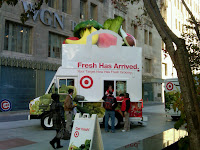
Cool ideas for sure. Transformative, perhaps. Great speech material? Absolutely.
Let's start with checkouts. Getting out of a store is probably the customers' number one pet peeve and the number one labor cost center for a store. And for decades, retailers have been trying to figure out a solution to both. Over twenty years ago, we saw the first self-serve checkouts at a Kroger store in Atlanta. Awkward and unwieldy at first, this technology eventually has become commonplace in many retailers, accounting for well over 25% of transactions. So, what's next? At the Kroger store in Hebron, Kentucky, you can see one approach. Their experimental Advantage checkout is a futuristic, high speed scanning belt that automatically scans products vs. the one at a time self-scan version. It looks a bit like an airport xray machine. Today, it is clearly early--there's more labor associated with running the experiment than the simple old-fashioned way. And, scan accuracy still has a way to go and exceptions remain a challenge. However, fast forward five years and this could be an enormous time and labor saver.

Another way to go about this is handheld scanning in aisle, which has been around for nearly ten years, indicative of how long the technology learning curve can be. However, in the new Carrefour Planet prototype in Lyon, they have made a big press in driving checkout innovation. For Carrefour, scan 'lib is an ambitious effort, supported in multiple areas in the store. As opposed to what we have seen in the US, the marketing and visual presence is a major difference and the "take" rate seems high.

Sticking with supermarkets, let's take the checkout process one step further. What if you didn't have to go in the store at all. Two retailers are experimenting with forms of curbside pick-up. Publix has two test locations and we saw one in Tampa. Simple enough in proposition, the customer pulls up into a designated parking space and communicates with the staff who brings their order to the car. There is some in-store marketing associated with the process but it is still relatively low key. At a minimum, it eases the process of in-store pick-up.

Taking this to another level is Auchan, which has two different offers in the market. One is ChronoDrive, a standalone effort that offers drive up pick-up service directly at a dedicated warehouse location. They also have AuchanDrive, which is located next to existing Auchan stores. It takes the effort further with dedicated drive up and a pick up session. There's a bit more technology involved where the customer types in a pin code that signals the staff. They claim several hundred customers per day, which is quite impressive.

OK, we admit to being vending junkies. And, the more bizarre, the better. There are some amazing vending options in Japan and some pretty cool ones cropping up in Europe. From the scratch baked pizza vending option in Italy to a fresh baked baguette in France, vending is certainly getting more ambitious. In the Monoprix store in Paris, 1 Euro gets you a fresh baked baguette, fully cooked in 60 seconds! The bread, by the way, isn't bad--hot, fresh and stayed soft for the day. The fact that it was sitting in front of a bakery didn't make much sense--it would seem to have more play where you can't get fresh bread.

Finally, pop-up hasn't gone away and we are moving fully into pop-up season. One cool marketing effort comes from Target (of course). Promoting their revamped P Fresh stores in Chicago, they created a pop-up marketing effort on Michigan Avenue, giving away bags of groceries to promote the extended offer, in conjunction with a lot of other media efforts (billboards, mobile trucks, newspaper) through the city.

Cool ideas for sure. Transformative, perhaps. Great speech material? Absolutely.
Friday, September 17, 2010
Walgreens fresh.real.now--Can they crack the convenience fresh code?


A few months back, Walgreens announced a planned expansion into the food business. The first evidence of this was the announcement of expanded food offers in so called "food deserts", typical inner city locales in urban markets. The first half dozen or so of these have debuted in Chicago already.
In a separate test, Walgreens also has planned an entry into the convenience fresh foods business. Imagine a place to buy fresh produce, sandwiches, salads and meals in nearly 7,000 Walgreens locations across the country, appealing to the time starved mom who is already shopping in their stores? That's the market opportunity being explored by these test stores.
The first location opened at North & Wells in Chicago's Old Town neighborhood. A second was nearly complete at 30 N. Michigan and another seven were planned this year.
While the area is branded fresh.real.now, individual products (entrees like pasta chicken marinara or lasagna) were branded under Corner Kitchen. The product generally looked fresh and appealing with reasonable prices. The branding certainly creates visibility and the location is prominent within the stores.
The real question: will customers (those busy moms) trust Walgreens as a fresh food source in the same way that they trust the brand for pharmacy? While the product looked good, the Walgreens brand is not necessarily synonymous with fresh and many retailers have struggled with selling packaged products. And, selling fresh goods can be a killer when they have to be thrown away--we saw a lot of produce, as an example, that has a very short shelf life.
We'll revisit again once they get these fully up and running. We suspect that there will be a lot of tinkering with the merchandise mix and that it will take time to build awareness (and acceptance) of the concept.
Thursday, August 19, 2010
Groupon Meets The Gap—The Old and New Combine…
The Groupon on August 19, 2010 represents a potential inflection point of sorts in retailing and the Internet. While we have been watching and marveling over local Chicago area upstart Groupon for the past few years (and have written about them several times), their Gap offer today represents a new direction for them. Groupon represents a unique combination of many of the unique aspects of the Internet—social media, group buying dynamics, and limited time discounts—into one package. A Groupon deal of the day is typically half-off or more a product or service geared to a local audience. Until today, the offers have primarily been geared around service offers—spas, nail salons, yoga classes, etc. More successful offers have been around discounted memberships to the Art Institute in Chicago or esoteric pursuits like skydiving classes. Sporting events, restaurants and food offers have also experienced huge impacts with Groupon offers. To date, however, these efforts have occurred on a highly localized level, generally geared towards small business within a limited geography. So, while Groupon has grown explosively (a quick glance at the website shows Groupon operating in 91 US cities and 21 countries around the world), the offers have always been geared at the local level in whatever city it’s been focused in.
Today’s offer with The Gap is typical in many respects in its structure—$50 worth of Gap merchandise for $25. http://www.groupon.com/deals/gap-inc-chicago
It is very atypical for several reasons:
This is a national Groupon. We did a quick check in several cities and saw the same offer around the country.
It’s the first deal we know of for a national chain the size and magnitude of Gap
Like most Groupon deals, this one tipped, and tipped early. Groupon typically displays the number of coupons purchased, which makes it easy to do the math and figure out the dollar value. Interestingly, they chose to eliminate the number and most individual cities simply say that thousands have been purchased. At 8:30 a.m. in Chicago, 8300 Groupons had been purchased, which quickly translates to over $200K in value. And most users were not even awake! On a national basis, we suspect that this will be a real test of the Groupon bump—can they move the needle on a chain the size and magnitude of The Gap? The potential dollar amount will be huge—certainly in the millions…
Perhaps today is Groupon’s coming of age, in combination with one of brick and mortar’s most venerable (but troubled) brands.
Today’s offer with The Gap is typical in many respects in its structure—$50 worth of Gap merchandise for $25. http://www.groupon.com/deals/gap-inc-chicago
It is very atypical for several reasons:
This is a national Groupon. We did a quick check in several cities and saw the same offer around the country.
It’s the first deal we know of for a national chain the size and magnitude of Gap
Like most Groupon deals, this one tipped, and tipped early. Groupon typically displays the number of coupons purchased, which makes it easy to do the math and figure out the dollar value. Interestingly, they chose to eliminate the number and most individual cities simply say that thousands have been purchased. At 8:30 a.m. in Chicago, 8300 Groupons had been purchased, which quickly translates to over $200K in value. And most users were not even awake! On a national basis, we suspect that this will be a real test of the Groupon bump—can they move the needle on a chain the size and magnitude of The Gap? The potential dollar amount will be huge—certainly in the millions…
Perhaps today is Groupon’s coming of age, in combination with one of brick and mortar’s most venerable (but troubled) brands.
Thursday, July 29, 2010
“Two Nations Divided by a Common Language"
 Engaging in a prolonged bit of retail therapy in London the past day or two, we were struck by the similarities and differences that still remain between the U.S. and England. Perhaps there’s no better way to look at the two countries than to compare retail businesses, something we’ve been doing now for over two decades. At this point in the post, we would attribute the above quote to someone but as in all things that can be “googled” today, even that’s no longer so simple (you can take your pick—it has been alternately credited to Shaw, Wilde or Churchill).
Figure 1: Hotel Chocolat
As we have pointed out before, however, the divide between the two nations has never been smaller, at least as concerns retail, which has become increasingly internationalized. On the High Streets of London (or Tokyo, New York or Seoul), retail reads like a true United Nations. One short strip along Kensington High Street says it all and does foretell the real future of retail—Japan’s Uniqlo sits next to U.K.’s TopShop which is nestled against US brands American Apparel, Diesel, and Urban Outfitters.
This leads us to one universal truth: The future of retail will be defined by great retailers, global in nature that can effectively provide a consistent branded experience while making the necessary refinements to succeed at a local market level.
Of course, this is far easier said than done as our retail visits confirm. If we were forced to sum up the UK experiences into one key difference, it would be housed around the term Refined Sensibility. There is a higher degree of information provided, consistently better storytelling and an overall refinement in the offer that seems to be missing too often in the US.
As we have pointed out before, however, the divide between the two nations has never been smaller, at least as concerns retail, which has become increasingly internationalized. On the High Streets of London (or Tokyo, New York or Seoul), retail reads like a true United Nations. One short strip along Kensington High Street says it all and does foretell the real future of retail—Japan’s Uniqlo sits next to U.K.’s TopShop which is nestled against US brands American Apparel, Diesel, and Urban Outfitters.
This leads us to one universal truth: The future of retail will be defined by great retailers, global in nature that can effectively provide a consistent branded experience while making the necessary refinements to succeed at a local market level.
Of course, this is far easier said than done as our retail visits confirm. If we were forced to sum up the UK experiences into one key difference, it would be housed around the term Refined Sensibility. There is a higher degree of information provided, consistently better storytelling and an overall refinement in the offer that seems to be missing too often in the US.
By evidence, we offer up the somewhat random experiences of:
· Pret a Manger, which defines freshness in a delightfully understated way;
· Hotel Chocolat, which brings a new level of experiential and sensorial delight to the category of chocolate;
· Waitrose, which launched their Essentials line of low priced private label with great flair;
· M&S, which communicates the benefits of newer meal solutions lines directly to consumers with sub-brands like Fuller Longer and Count on Us;
· And one of our favorite little brands Neal’s Yard Remedies which is intelligently pursuing natural and homeopathic ingredients in beauty care.
 What’s on the US side of the ledger? Based on what’s crossed over to date, we would sum it up in another word, Theater.
· The Whole Foods on Kensington appears to be closer to hitting its stride after a financially disastrous debut. We saw much better distribution of traffic than in prior visits with the suggestion that they are finally finding their footing (though we would never want to be paying their rent!). Losses in the UK continue but they seem to be in a more manageable range.
Figure 2: Anthropologie
· Easily the most spectacular store in our visit was the new Anthropologie store on Kings Road in Chelsea. Housed in a former antique market space with high ceilings and stunning stained glass, this is truly a cathedral for retailing—they could charge admission to this open, airy, inspiring retail playground.
With retail playing at an elevated level in both countries, we will expect to see a lot more crossovers in the future. British fast fashion is already making inroads with TopShop, which has had a big opening in SoHo (ours, not theirs)and we expect AllSaints to make a similar splash as it brings its vintage grunge rock sensibilities over to New York this year.
Figure 3: All Saints
 No surprise—Retail Watching now, more than ever, needs to be an international activity.
Subscribe to:
Posts (Atom)