We just finished up a week of meetings and store visits in China. The amount of information we now have on the market could fill a thimble—a few trips hardly qualifies one as an expert. Of course, that won’t stop us, so here goes.
The statistics, as we have discussed before, boggle the mind. A population of 1.3 billion people, a rising economy and over 250 cities with more than a million people presents opportunities at nearly every turn. What could possibly go wrong for companies who are positioning themselves to do business in what will easily be the world’s largest economy in the not too distant future? Plenty, as it turns out.
During the week of our visit, two unrelated news stories caught our attention. The first is Best Buy’s decision to close their nine branded stores in China. While they will still have an investment in a Chinese electronics retailer, Five Star, closing their eponymous brand feels like an early signal of defeat. Observationally, the Chinese market for appliances and electronics looks and feels very different than the U.S. Price dominates and the stores are loud and noisy, populated by brand supplied salespeople in an environment where negotiation is expected. Gome, the large Chinese retailer, currently dominates. Best Buy, with an elevated customer experience, was way out ahead of the curve.
The complementary story of the quiet closing of the six story House of Barbie flagship store in Shanghai was even more surprising. This much written about experiential store was the global equivalent of American Girl and had just opened in 2009. The costs to operate, and/or the costs to close both had to have been substantial. This is a store that was more a brand builder than a money maker, even at the outset. It must have been losing even more money than even planned to pull the plug this early. Since Barbie’s owner, Mattel, is not a retailer, we would suspect some significant miscalculations on their part in what it takes to operate a Flagship retail store.
Home Depot is also in retreat, closing the Beijing outlets acquired when they purchased local retailer Home Way. To be equal opportunity with International struggles, the French DIY chain Saint-Gobain is also pulling out of the China market. The DIY market in China is far less developed, as apartments tend to come fully equipped.
The China market is large (and growing at incredible rates) but is also intensely competitive. Local regulations further hamper foreign businesses and bodies in the store (of which there are lots) don’t always translate into high sales. Average transaction size and sales density are quite low (in most cases) for now. The market is “open” but you’re never very far from remembering that this is a Communist country tightly controlled by the government. We couldn’t access our Blog page in China—censored (apparently) by the government!
This is definitely a market where investing for the future is required—quick returns are likely not there. Exceptions include a booming luxury goods market and a preponderance of very successful (think KFC) fast feeders. As the large global retailers (Auchan, Tesco, Carrefour, Walmart) battle it out, China will be a fascinating retail landscape to watch over the next decade. It decidedly is not, however, for the faint of heart.

Tuesday, March 22, 2011


Monday, February 21, 2011
Ano"Mall"ies--Three Great Shopping Centers

Santa Monica Place
One of the side benefits of the massive winter storm we had a few weeks back was getting "stranded' in Los Angeles and London. While "idle hands may be the devil's tools", at McMillanDoolittle that just means more time to go and visit stores.
And while we are always fascinated with new retail concepts and stores, the malls that they are housed in have become so increasingly vanilla that they hardly merit a look. The story in the shopping center industry is the same as many others--consolidation, scale, efficiency=blandness.
There are exceptions to the rule and we visited three amazing centers (separated by a lot of geography) more or less back to back to back. The Grove and Santa Monica Place are two bright spots in Southern California and the Westfield Center in Shepherd's Bush in London represents an extraordinary shopping center achievement.

Desigual--The hot Spanish retailer at Westfield
When trying to distill common elements from these very different properties, we summarize a few of the key elements as follows:
Great Stores. This should go without saying but the hallmark of a great shopping center begins with the tenant mix. The old formula for a shopping center would consist of three to four main anchor tenants and then "fill in the rest". The one common point of these centers is that they are decidely not defined by anchors. While there is some good anchors here and there at these centers, they are better defined by an interesting mix of smaller retailers. Increasingly, the retail landscape is defined by global brands that bringing news and freshness to centers. Nike, AllSaints, Apple (of course), Anthropologie are just a few of the standouts.
Great Entertainment Options. All three centers work as great places to hang out, offering a number of casual dining options to full sit down variety. Restaurant Row at Westfield is a destination unto itself. What is clear is that the "food court" has become a bit anachronistic as options become spread throughout the space. Santa Monica Place will add a "Market" feature shortly to bring more food specialists into the fold.

The Market--Coming soon at Santa Monica Place
Segmented Offerings. It certainly helps to be reasonably new and build natural destination centers within a greater space. Grouping luxury retailers in one space, teen retailers within another and kid's retail in their own zones helps shoppers naturally find stores of interest. The retailers, too, benefit from proximity of their own targeted customers.
Great Space. The Grove and Santa Monica Place have the advantage of being open air facilities in a great geography. Westfield in London faces a decidely different challenge. Yet, all have utilized high ceilings to create a sense of space within the stores, ample public meeting spaces and room to freely roam.
Natural Proximity. The Grove naturally feeds into the iconic Los Angeles Farmer's Market, Santa Monica Place into well-established street retail and Westfield into a huge transportation hub. No accident that great centers also offer great adjacent draws.
These centers certainly have their unique elements. They also contain some lessons for existing centers as well as new developments underway. Hopefully, they will no longer be anomalies in the future.
Friday, January 21, 2011
Starbucks New Prototype Heads in the Right Direction
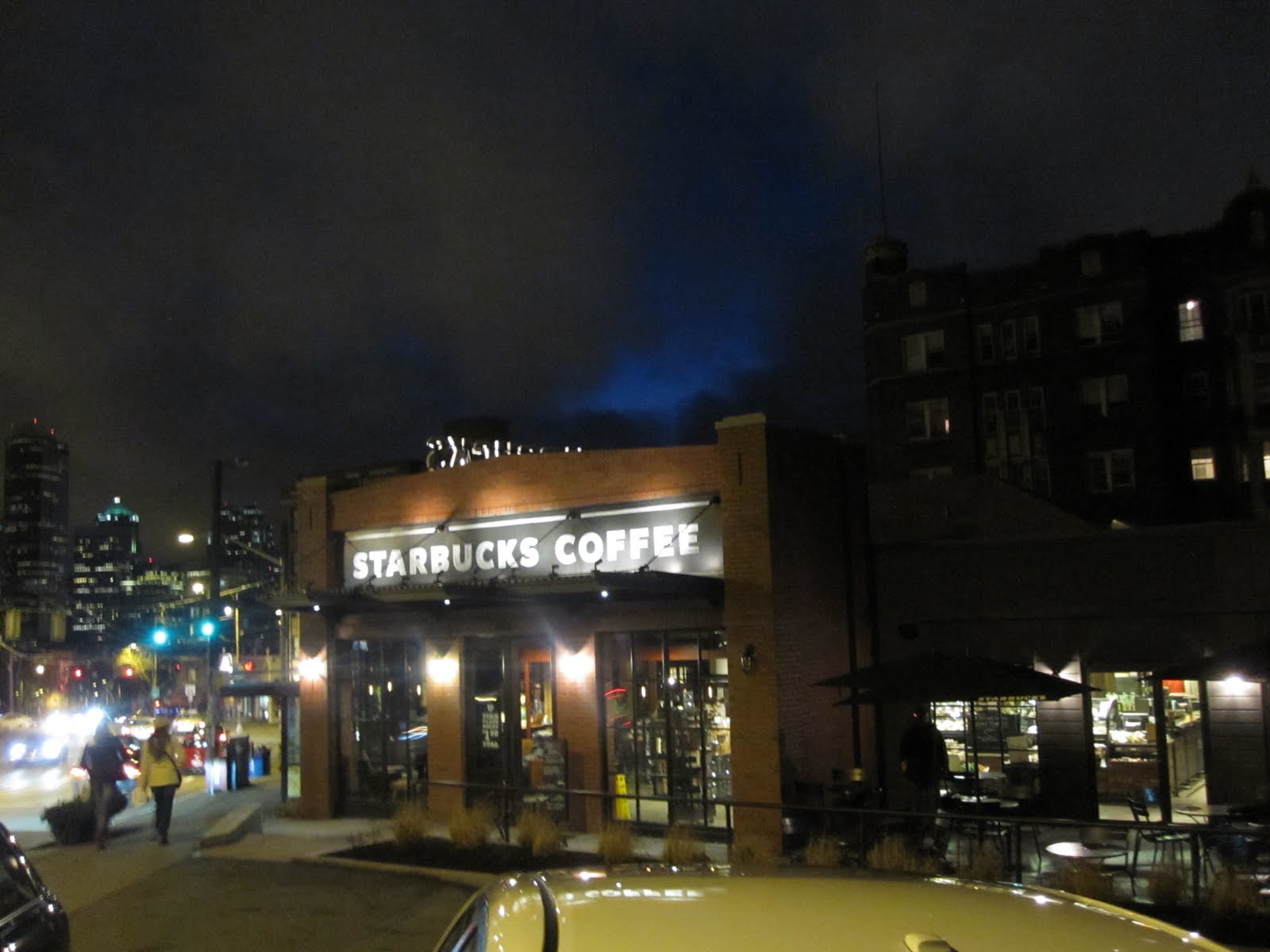

Starbucks' renaissance under Howard Schultz's direction has been relatively well documented. And, it has been a fairly significant financial success, from closing a number of underperforming stores that had sprouted like weeds to reinvesting back in the core product (coffee). But, it hasn't been without some hiccups along the way. There was a foray into value pricing, seevral attempts at reinvigorating the food offer (oatmeal seems to have finally worked) and the latest high profile logo change (better than Gap but we have some issues...).
One of the most interesting tests during this period was the un-Starbucking of an actual store, opting for a local flair in Seattle under the name 15th Avenue Coffee and Tea. Designed to invoke more of the warmth of a local coffee shop, this store attempted to market the brand incognito. While this was an obvious attempt to counter the commercialization and ubiquity of Starbucks as well as addressing the decline of "third place" status, we weren't enamored from the start. Customers can too easily see through this type of artifice. The real key is to change what Starbucks stands for (at its roots--the best coffee and the third place) rather than substitute a different name. Last week, they announced the merciful ending of the 15th Avenue experiment.
At the same time, elements of that idea are now being rolled out into next generation Starbucks prototype. The latest, in Seattle, on Olive Way, represents how that new direction can be managed under the Starbucks brand. The space is vast and open, filled with environmentally friendly touches. It was filled during our visit with people happier to gave a real third place to hang at. There are fewer barriers between barista and customer and a significantly more relaxed vibe. The menu expands to include wine and beer (intriguing to say the least) and Starbucks Reserve coffee gets heavier play.
While this store is expensive to build, takes a fair amount of real estate and would seem challenged to handle peak rushes, it certainly elevates the brand to a hip place worth hanging out at.
Stay tuned as the experience continues to evolve.
Thursday, October 28, 2010
Cool Things We See on the Way To See Other Things...
We give a lot of presentations around the world. And, without a doubt, the things that always generate the most interest are the cool little things that often aren't very material to the business. Climbing walls, wave machines, shoe vending machines...people love them. This time, we have some random cool techy things to talk about with some wonderful juxtaposition of activities in Europe vs. the U.S.
Let's start with checkouts. Getting out of a store is probably the customers' number one pet peeve and the number one labor cost center for a store. And for decades, retailers have been trying to figure out a solution to both. Over twenty years ago, we saw the first self-serve checkouts at a Kroger store in Atlanta. Awkward and unwieldy at first, this technology eventually has become commonplace in many retailers, accounting for well over 25% of transactions. So, what's next? At the Kroger store in Hebron, Kentucky, you can see one approach. Their experimental Advantage checkout is a futuristic, high speed scanning belt that automatically scans products vs. the one at a time self-scan version. It looks a bit like an airport xray machine. Today, it is clearly early--there's more labor associated with running the experiment than the simple old-fashioned way. And, scan accuracy still has a way to go and exceptions remain a challenge. However, fast forward five years and this could be an enormous time and labor saver.

Another way to go about this is handheld scanning in aisle, which has been around for nearly ten years, indicative of how long the technology learning curve can be. However, in the new Carrefour Planet prototype in Lyon, they have made a big press in driving checkout innovation. For Carrefour, scan 'lib is an ambitious effort, supported in multiple areas in the store. As opposed to what we have seen in the US, the marketing and visual presence is a major difference and the "take" rate seems high.

Sticking with supermarkets, let's take the checkout process one step further. What if you didn't have to go in the store at all. Two retailers are experimenting with forms of curbside pick-up. Publix has two test locations and we saw one in Tampa. Simple enough in proposition, the customer pulls up into a designated parking space and communicates with the staff who brings their order to the car. There is some in-store marketing associated with the process but it is still relatively low key. At a minimum, it eases the process of in-store pick-up.

Taking this to another level is Auchan, which has two different offers in the market. One is ChronoDrive, a standalone effort that offers drive up pick-up service directly at a dedicated warehouse location. They also have AuchanDrive, which is located next to existing Auchan stores. It takes the effort further with dedicated drive up and a pick up session. There's a bit more technology involved where the customer types in a pin code that signals the staff. They claim several hundred customers per day, which is quite impressive.

OK, we admit to being vending junkies. And, the more bizarre, the better. There are some amazing vending options in Japan and some pretty cool ones cropping up in Europe. From the scratch baked pizza vending option in Italy to a fresh baked baguette in France, vending is certainly getting more ambitious. In the Monoprix store in Paris, 1 Euro gets you a fresh baked baguette, fully cooked in 60 seconds! The bread, by the way, isn't bad--hot, fresh and stayed soft for the day. The fact that it was sitting in front of a bakery didn't make much sense--it would seem to have more play where you can't get fresh bread.

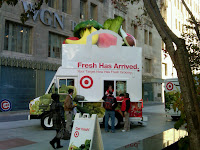
Finally, pop-up hasn't gone away and we are moving fully into pop-up season. One cool marketing effort comes from Target (of course). Promoting their revamped P Fresh stores in Chicago, they created a pop-up marketing effort on Michigan Avenue, giving away bags of groceries to promote the extended offer, in conjunction with a lot of other media efforts (billboards, mobile trucks, newspaper) through the city.
Cool ideas for sure. Transformative, perhaps. Great speech material? Absolutely.
Let's start with checkouts. Getting out of a store is probably the customers' number one pet peeve and the number one labor cost center for a store. And for decades, retailers have been trying to figure out a solution to both. Over twenty years ago, we saw the first self-serve checkouts at a Kroger store in Atlanta. Awkward and unwieldy at first, this technology eventually has become commonplace in many retailers, accounting for well over 25% of transactions. So, what's next? At the Kroger store in Hebron, Kentucky, you can see one approach. Their experimental Advantage checkout is a futuristic, high speed scanning belt that automatically scans products vs. the one at a time self-scan version. It looks a bit like an airport xray machine. Today, it is clearly early--there's more labor associated with running the experiment than the simple old-fashioned way. And, scan accuracy still has a way to go and exceptions remain a challenge. However, fast forward five years and this could be an enormous time and labor saver.

Another way to go about this is handheld scanning in aisle, which has been around for nearly ten years, indicative of how long the technology learning curve can be. However, in the new Carrefour Planet prototype in Lyon, they have made a big press in driving checkout innovation. For Carrefour, scan 'lib is an ambitious effort, supported in multiple areas in the store. As opposed to what we have seen in the US, the marketing and visual presence is a major difference and the "take" rate seems high.

Sticking with supermarkets, let's take the checkout process one step further. What if you didn't have to go in the store at all. Two retailers are experimenting with forms of curbside pick-up. Publix has two test locations and we saw one in Tampa. Simple enough in proposition, the customer pulls up into a designated parking space and communicates with the staff who brings their order to the car. There is some in-store marketing associated with the process but it is still relatively low key. At a minimum, it eases the process of in-store pick-up.

Taking this to another level is Auchan, which has two different offers in the market. One is ChronoDrive, a standalone effort that offers drive up pick-up service directly at a dedicated warehouse location. They also have AuchanDrive, which is located next to existing Auchan stores. It takes the effort further with dedicated drive up and a pick up session. There's a bit more technology involved where the customer types in a pin code that signals the staff. They claim several hundred customers per day, which is quite impressive.

OK, we admit to being vending junkies. And, the more bizarre, the better. There are some amazing vending options in Japan and some pretty cool ones cropping up in Europe. From the scratch baked pizza vending option in Italy to a fresh baked baguette in France, vending is certainly getting more ambitious. In the Monoprix store in Paris, 1 Euro gets you a fresh baked baguette, fully cooked in 60 seconds! The bread, by the way, isn't bad--hot, fresh and stayed soft for the day. The fact that it was sitting in front of a bakery didn't make much sense--it would seem to have more play where you can't get fresh bread.

Finally, pop-up hasn't gone away and we are moving fully into pop-up season. One cool marketing effort comes from Target (of course). Promoting their revamped P Fresh stores in Chicago, they created a pop-up marketing effort on Michigan Avenue, giving away bags of groceries to promote the extended offer, in conjunction with a lot of other media efforts (billboards, mobile trucks, newspaper) through the city.

Cool ideas for sure. Transformative, perhaps. Great speech material? Absolutely.
Friday, September 17, 2010
Walgreens fresh.real.now--Can they crack the convenience fresh code?


A few months back, Walgreens announced a planned expansion into the food business. The first evidence of this was the announcement of expanded food offers in so called "food deserts", typical inner city locales in urban markets. The first half dozen or so of these have debuted in Chicago already.
In a separate test, Walgreens also has planned an entry into the convenience fresh foods business. Imagine a place to buy fresh produce, sandwiches, salads and meals in nearly 7,000 Walgreens locations across the country, appealing to the time starved mom who is already shopping in their stores? That's the market opportunity being explored by these test stores.
The first location opened at North & Wells in Chicago's Old Town neighborhood. A second was nearly complete at 30 N. Michigan and another seven were planned this year.
While the area is branded fresh.real.now, individual products (entrees like pasta chicken marinara or lasagna) were branded under Corner Kitchen. The product generally looked fresh and appealing with reasonable prices. The branding certainly creates visibility and the location is prominent within the stores.
The real question: will customers (those busy moms) trust Walgreens as a fresh food source in the same way that they trust the brand for pharmacy? While the product looked good, the Walgreens brand is not necessarily synonymous with fresh and many retailers have struggled with selling packaged products. And, selling fresh goods can be a killer when they have to be thrown away--we saw a lot of produce, as an example, that has a very short shelf life.
We'll revisit again once they get these fully up and running. We suspect that there will be a lot of tinkering with the merchandise mix and that it will take time to build awareness (and acceptance) of the concept.
Thursday, August 19, 2010
Groupon Meets The Gap—The Old and New Combine…
The Groupon on August 19, 2010 represents a potential inflection point of sorts in retailing and the Internet. While we have been watching and marveling over local Chicago area upstart Groupon for the past few years (and have written about them several times), their Gap offer today represents a new direction for them. Groupon represents a unique combination of many of the unique aspects of the Internet—social media, group buying dynamics, and limited time discounts—into one package. A Groupon deal of the day is typically half-off or more a product or service geared to a local audience. Until today, the offers have primarily been geared around service offers—spas, nail salons, yoga classes, etc. More successful offers have been around discounted memberships to the Art Institute in Chicago or esoteric pursuits like skydiving classes. Sporting events, restaurants and food offers have also experienced huge impacts with Groupon offers. To date, however, these efforts have occurred on a highly localized level, generally geared towards small business within a limited geography. So, while Groupon has grown explosively (a quick glance at the website shows Groupon operating in 91 US cities and 21 countries around the world), the offers have always been geared at the local level in whatever city it’s been focused in.
Today’s offer with The Gap is typical in many respects in its structure—$50 worth of Gap merchandise for $25. http://www.groupon.com/deals/gap-inc-chicago
It is very atypical for several reasons:
This is a national Groupon. We did a quick check in several cities and saw the same offer around the country.
It’s the first deal we know of for a national chain the size and magnitude of Gap
Like most Groupon deals, this one tipped, and tipped early. Groupon typically displays the number of coupons purchased, which makes it easy to do the math and figure out the dollar value. Interestingly, they chose to eliminate the number and most individual cities simply say that thousands have been purchased. At 8:30 a.m. in Chicago, 8300 Groupons had been purchased, which quickly translates to over $200K in value. And most users were not even awake! On a national basis, we suspect that this will be a real test of the Groupon bump—can they move the needle on a chain the size and magnitude of The Gap? The potential dollar amount will be huge—certainly in the millions…
Perhaps today is Groupon’s coming of age, in combination with one of brick and mortar’s most venerable (but troubled) brands.
Today’s offer with The Gap is typical in many respects in its structure—$50 worth of Gap merchandise for $25. http://www.groupon.com/deals/gap-inc-chicago
It is very atypical for several reasons:
This is a national Groupon. We did a quick check in several cities and saw the same offer around the country.
It’s the first deal we know of for a national chain the size and magnitude of Gap
Like most Groupon deals, this one tipped, and tipped early. Groupon typically displays the number of coupons purchased, which makes it easy to do the math and figure out the dollar value. Interestingly, they chose to eliminate the number and most individual cities simply say that thousands have been purchased. At 8:30 a.m. in Chicago, 8300 Groupons had been purchased, which quickly translates to over $200K in value. And most users were not even awake! On a national basis, we suspect that this will be a real test of the Groupon bump—can they move the needle on a chain the size and magnitude of The Gap? The potential dollar amount will be huge—certainly in the millions…
Perhaps today is Groupon’s coming of age, in combination with one of brick and mortar’s most venerable (but troubled) brands.
Thursday, July 29, 2010
“Two Nations Divided by a Common Language"
 Engaging in a prolonged bit of retail therapy in London the past day or two, we were struck by the similarities and differences that still remain between the U.S. and England. Perhaps there’s no better way to look at the two countries than to compare retail businesses, something we’ve been doing now for over two decades. At this point in the post, we would attribute the above quote to someone but as in all things that can be “googled” today, even that’s no longer so simple (you can take your pick—it has been alternately credited to Shaw, Wilde or Churchill).
Figure 1: Hotel Chocolat
As we have pointed out before, however, the divide between the two nations has never been smaller, at least as concerns retail, which has become increasingly internationalized. On the High Streets of London (or Tokyo, New York or Seoul), retail reads like a true United Nations. One short strip along Kensington High Street says it all and does foretell the real future of retail—Japan’s Uniqlo sits next to U.K.’s TopShop which is nestled against US brands American Apparel, Diesel, and Urban Outfitters.
This leads us to one universal truth: The future of retail will be defined by great retailers, global in nature that can effectively provide a consistent branded experience while making the necessary refinements to succeed at a local market level.
Of course, this is far easier said than done as our retail visits confirm. If we were forced to sum up the UK experiences into one key difference, it would be housed around the term Refined Sensibility. There is a higher degree of information provided, consistently better storytelling and an overall refinement in the offer that seems to be missing too often in the US.
As we have pointed out before, however, the divide between the two nations has never been smaller, at least as concerns retail, which has become increasingly internationalized. On the High Streets of London (or Tokyo, New York or Seoul), retail reads like a true United Nations. One short strip along Kensington High Street says it all and does foretell the real future of retail—Japan’s Uniqlo sits next to U.K.’s TopShop which is nestled against US brands American Apparel, Diesel, and Urban Outfitters.
This leads us to one universal truth: The future of retail will be defined by great retailers, global in nature that can effectively provide a consistent branded experience while making the necessary refinements to succeed at a local market level.
Of course, this is far easier said than done as our retail visits confirm. If we were forced to sum up the UK experiences into one key difference, it would be housed around the term Refined Sensibility. There is a higher degree of information provided, consistently better storytelling and an overall refinement in the offer that seems to be missing too often in the US.
By evidence, we offer up the somewhat random experiences of:
· Pret a Manger, which defines freshness in a delightfully understated way;
· Hotel Chocolat, which brings a new level of experiential and sensorial delight to the category of chocolate;
· Waitrose, which launched their Essentials line of low priced private label with great flair;
· M&S, which communicates the benefits of newer meal solutions lines directly to consumers with sub-brands like Fuller Longer and Count on Us;
· And one of our favorite little brands Neal’s Yard Remedies which is intelligently pursuing natural and homeopathic ingredients in beauty care.
 What’s on the US side of the ledger? Based on what’s crossed over to date, we would sum it up in another word, Theater.
· The Whole Foods on Kensington appears to be closer to hitting its stride after a financially disastrous debut. We saw much better distribution of traffic than in prior visits with the suggestion that they are finally finding their footing (though we would never want to be paying their rent!). Losses in the UK continue but they seem to be in a more manageable range.
Figure 2: Anthropologie
· Easily the most spectacular store in our visit was the new Anthropologie store on Kings Road in Chelsea. Housed in a former antique market space with high ceilings and stunning stained glass, this is truly a cathedral for retailing—they could charge admission to this open, airy, inspiring retail playground.
With retail playing at an elevated level in both countries, we will expect to see a lot more crossovers in the future. British fast fashion is already making inroads with TopShop, which has had a big opening in SoHo (ours, not theirs)and we expect AllSaints to make a similar splash as it brings its vintage grunge rock sensibilities over to New York this year.
Figure 3: All Saints
 No surprise—Retail Watching now, more than ever, needs to be an international activity.
Subscribe to:
Posts (Atom)