“We sincerely apologize about the delay on your product delivery.” These are not the words that you want to see when you open your email, particularly with something as essential as diapers. At the beginning of June, we purchased a $25 Groupon for $50 worth of product from diapersdirect.com. We promptly placed our order (as many others did as well), and received our diapers in mid-June. Apparently, we were one of the lucky ones, as we discovered that this was the fourth email that Groupon customers had received regarding unfulfilled orders. So, we did a little digging and this is what we found:
• A quick Google search indicates that Diapers Direct offered a Groupon in Amarillo on May 11 which was purchased by 1,396 Groupon-ers. Over the course of the next 3 ½ weeks, this deal was featured in at least five other cities and purchased by over 900 additional customers. As we read the email mentioned above further, Diapers Direct goes on to state, “An estimated 98% of Groupon customers at our website have used their coupon within one day of purchasing it. The steady stream of customers over a six month period that we had planned for became a tidal wave of orders all made in the past thirty days.” Recent data from Groupon is consistent, with only 10% redeeming their coupon within one month, but if nearly 1,400 orders were placed on day one, this leaves us scratching our heads as to why Diapers Direct didn’t pull the deal after the first tidal wave of orders.
• Diapers Direct is a small business (with only 3 employees, according to their email) that presumably used Groupon in order to get a couple hundred new customers. “We have had commercial customers that purchased as many as 110 Groupon coupons.” Unfortunately, they didn’t set a limit on how many people could purchase their coupon and they instantly became overwhelmed.
• In a recent study on daily deal sites conducted by Rice University, nearly 80% of coupon users are first-timers, and only 20% of them become repeat customers. This conversion rate does not bode well for Diapers Direct (particularly since so many customers still have open orders). “We are by nature a recurring order company. A company designed to make monthly deliveries to a regular repeat customer base.” We’re betting the commercial customers mentioned above were not planning to become repeat customers. What’s more, any pre-existing customers are likely having a difficult time placing non-Groupon orders, damaging their existing customer base.
So what are the lessons learned?
• Know how Groupon works. Understand everything from what percentage Groupon will take of your profit, how many coupons the deal is limited to and how many coupons are available to purchase for each customer.
• Ensure your business can cover the discount you will offer. Diapers Direct planned to “lose a little money on every transaction and expected to do so as this was our way of introducing ourselves to all of you.” They likely did not plan for as many transactions as they got.
• Plan for best and worst case scenarios. Can you accommodate 1,000 new customers? Have you ordered additional stock for the initial wave of orders and the final month of your deal as customers try to use their soon-to-expire Groupons? Do you have enough staff to accommodate the influx of orders? Even if Diapers Direct had all product in stock, three employees could not efficiently and effectively fill all orders in a timely manner.
Groupon is bigger and more powerful than most of us understand. It’s either a quick way to double your sales or to go out of business.
There’s no question that Groupon, Living Social and the myriad of competitors are nothing short of a global phenomenon in retailing, service and foodservice businesses over the past two years or so. It is equally clear that there is much that’s unknown about these offers, particularly as it relates to both short and long-term success. We know the old saying Caveat Emptor (buyer beware!). In this instance, Caveat Venditor (seller beware!).
This is a guest blog from Felicia Greenbaum, McMillanDoolittle Business Manager

Wednesday, July 13, 2011


Monday, July 11, 2011
Bloomingdales.com--The devil is (apparently lost) in the details
It is wonderful to see how well Macy's Inc. (parent of Bloomingdales) has been doing of late. They are in their second year of comp store increases and they do seem to have the company heading in the right direction. In their last press release, they also made note that their e-commerce division is performing even better--up a spectacular 40% year to year.
As a retail consultant, we tend to live in the kind of numbers above. As a customer, things tend to be a little different. We recently bought some California King sheets during a great sale at Bloomingdales...good item, great price, etc...
When the sheets arrived (in a horribly oversized box with no padding, by the way), they were not the "latte" clor we wanted but a very lovely purple. This is despite the fact that the bar code tag said latte...oops.
So, now what?
1. Called our local store who nicely explained that they don't sell Cal Kings in Chicago but we could try and call a California store...
2. Returned the item (at our expense) and explained they got the color wrong
3. A few weeks later, the replacement comes...and yes, still purple! Two observations--they clearly mis-tagged the product and; there is no human checkpoint to distinguish between latte and purple..
4. Return the sheets to a local store and (again) explain the problem. Their advice? Wait about 30 days before ordering again and HOPEFULLY, they will have figured out the whole latte/purple mix up by then
5. Receive a Bloomie's gift card (no credit refund) for an amount that is less the cost of the original shipping, return shipping, etc
6. Bottom line--no sheets, an enormous hassle and out money
What's wrong with this picture? It's almost impossible to figure out where to begin--failures in process, quality control, customer service, and so on.
It's nice to hear that on-line sales are up 40% but how will they be able to position themselves in the long run against a growing number of competitors who have figured this stuff out?
As a retail consultant, we tend to live in the kind of numbers above. As a customer, things tend to be a little different. We recently bought some California King sheets during a great sale at Bloomingdales...good item, great price, etc...
When the sheets arrived (in a horribly oversized box with no padding, by the way), they were not the "latte" clor we wanted but a very lovely purple. This is despite the fact that the bar code tag said latte...oops.
So, now what?
1. Called our local store who nicely explained that they don't sell Cal Kings in Chicago but we could try and call a California store...
2. Returned the item (at our expense) and explained they got the color wrong
3. A few weeks later, the replacement comes...and yes, still purple! Two observations--they clearly mis-tagged the product and; there is no human checkpoint to distinguish between latte and purple..
4. Return the sheets to a local store and (again) explain the problem. Their advice? Wait about 30 days before ordering again and HOPEFULLY, they will have figured out the whole latte/purple mix up by then
5. Receive a Bloomie's gift card (no credit refund) for an amount that is less the cost of the original shipping, return shipping, etc
6. Bottom line--no sheets, an enormous hassle and out money
What's wrong with this picture? It's almost impossible to figure out where to begin--failures in process, quality control, customer service, and so on.
It's nice to hear that on-line sales are up 40% but how will they be able to position themselves in the long run against a growing number of competitors who have figured this stuff out?
Thursday, May 19, 2011
Apple: A Decade of Retail Revolution

On May 19, 2001, the first Apple stores opened (more or less simultaneously) in Tysons Corner, Virginia and the Glendale Galleria. While the stores were eagerly awaited, they were also greeted with some understandable skepticism. Gateway had notably flamed out in retail, having to close all of their stores and Sony had been flip-flopping with a retail strategy during this same time period as well.
One of our favorite quotes on Apple’s retail strategy comes from a story headlined: Sorry Steve, Here’s Why Retail Stores Won’t Work. The story explains in some detail why getting into retail is a bad idea and ends with a quote from David A. Goldstein, who states, "I give them two years before they're turning out the lights on a very painful and expensive mistake".
Unfortunately, for us, David had some company. In our Retail Watch newsletter from July of 2001, we extol on the virtues of how cool the stores, saying “it helps that Apple’s stuff is cool itself—their product design is second to none and showcased within this amazing new environment”. Unfortunately, we also go on to say, “It will be very hard to ever make any money”. Oops.
So, how are the Apple stores doing? Well, we were only a few billion dollars off when assessing future profitability! In fact, the stores are obscenely profitable—300 stores Internationally, and over $2 billion in profits on $9 billion in sales. More to the point, they are one of the few branded retail stores (Nike and Coach join the ranks) that succeed in both elevating the image of the overall brand while delivering high levels of profitability.
Other numbers are equally astounding:
• Sales per square foot, a key measure in a retailer’s productivity, are estimated at around $5,000 per square foot! No one else in retail even comes close.
• Traffic counts are equally amazing, particularly in such a condensed space. Apple is averaging 15,000 customers per week in their stores, which is extraordinary given the compact store size.
Now, since we owned up to a “slightly” off prediction on Apple’s retail prospects, we also want to point out that it is a radically different company today than in 2001 (here comes the mea culpa):
• In 2001, Apple was a relatively small computer seller with a 3% market share. We still maintain that those margins on computers and the relative difficulty of the computer sales cycle does make selling "computers" profitably a daunting experience. Apple was “only” a $5 billion company back in 2001.
• Apple is now a huge consumer products retailer. Selling iPods, iTouches, iPhones and the like, in droves, is a very efficient retail proposition, accompanied by higher (and controlled) margins. The relative levels of profitability (and overall revenues) sky-rocketed once this shift took place. For history’s sake, the first iPod debuted in October of 2001 while the country was pre-occupied with post 9/11 matters. In 2011, Apple could well hit $100 billion in total revenues. Wow!
So, it becomes a classic "chicken and egg" dilemma. Could have Apple ever been a successful retailer without the dramatic introduction of game changing products like the iPOd? Conversely, would those products ever had a chance to shine without dedicated retail distribution?
The flipside of Apple’s retail success is that it has encouraged a number of other companies to follow suit. Few, if any (though we’re careful NOW not to make sweeping predictions) will ever come close to reaching Apple’s success: A rare combination of brand, product and an extraordinary retail experience came together to forge this remarkable game-changing retail story. Most companies will find themselves lacking in one or all of these areas.
There are rumors that version 2.0 of Apple retail is on the way. We can't wait.
Thursday, May 12, 2011
Who Moved My Chipotle?

In my hometown of LaGrange, Illinois, something curious has happened. The (and one can only presume based on dozens of visits) fabulously successful Chipotle branch in the heart of our downtown moved…approximately three blocks away. Now while this would not seem to be of particular consequence, there are some extenuating circumstances behind the move:
• It moved to the “other” side of the tracks. While the original location was directly across from the commuter train stop, the new location is a block or so North, at the intersection of the two busiest roads in town.
• It moved, very ironically, into a recently closed Baja Fresh location. Yes, it was pre-wired for burritos but the next logical question follows…why exactly did this Baja close?
• It moved to a location with parking, though shared with Walgreens, Caribou and an AT&T store. The parking is certainly a plus over the sometimes “impossible to find a space” downtown location.
So, you ask—what’s the problem? They stayed in the hood and added parking. Let’s examine the other side of the ledger:
• The new location feels (and almost certainly is) smaller. Seating only is for around 50 (at best). Worse, there is no separation between the seats and the line so there is a decidedly uncomfortable feel while queuing or eating. While we have been in tighter Chipotle spaces, the old space (long, with high, exposed ceilings and real character) had a significantly more pleasant feel and atmosphere.
• The old Chipotle was incredibly popular with the teenage crowd. Along with Starbucks a block or so away, it was the de facto hangout in town. Who wants teens hanging around? As long as those teens have money (which the La Grangian version most certainly do), why not. This location is not nearly as central to the walking crowd which is a significant part of downtown traffic, particularly during the (admittedly rare) nice days of Chicago.
In all, a curious move. Could the addition of parking trump all of the other negatives? Was the landlord simply impossible to deal with? We’ll find out. We suspect that business will be down but maybe Chipotle’s magic trumps even a bad real estate play. While we are huge fans of Chipotle, we are once again reminded that all retail is local--while they are winning big time on a national scale, this might be a local loss.
Tuesday, March 22, 2011
China: Enormous Opportunity, Enormously Difficult
We just finished up a week of meetings and store visits in China. The amount of information we now have on the market could fill a thimble—a few trips hardly qualifies one as an expert. Of course, that won’t stop us, so here goes.
The statistics, as we have discussed before, boggle the mind. A population of 1.3 billion people, a rising economy and over 250 cities with more than a million people presents opportunities at nearly every turn. What could possibly go wrong for companies who are positioning themselves to do business in what will easily be the world’s largest economy in the not too distant future? Plenty, as it turns out.
During the week of our visit, two unrelated news stories caught our attention. The first is Best Buy’s decision to close their nine branded stores in China. While they will still have an investment in a Chinese electronics retailer, Five Star, closing their eponymous brand feels like an early signal of defeat. Observationally, the Chinese market for appliances and electronics looks and feels very different than the U.S. Price dominates and the stores are loud and noisy, populated by brand supplied salespeople in an environment where negotiation is expected. Gome, the large Chinese retailer, currently dominates. Best Buy, with an elevated customer experience, was way out ahead of the curve.
The complementary story of the quiet closing of the six story House of Barbie flagship store in Shanghai was even more surprising. This much written about experiential store was the global equivalent of American Girl and had just opened in 2009. The costs to operate, and/or the costs to close both had to have been substantial. This is a store that was more a brand builder than a money maker, even at the outset. It must have been losing even more money than even planned to pull the plug this early. Since Barbie’s owner, Mattel, is not a retailer, we would suspect some significant miscalculations on their part in what it takes to operate a Flagship retail store.
Home Depot is also in retreat, closing the Beijing outlets acquired when they purchased local retailer Home Way. To be equal opportunity with International struggles, the French DIY chain Saint-Gobain is also pulling out of the China market. The DIY market in China is far less developed, as apartments tend to come fully equipped.
The China market is large (and growing at incredible rates) but is also intensely competitive. Local regulations further hamper foreign businesses and bodies in the store (of which there are lots) don’t always translate into high sales. Average transaction size and sales density are quite low (in most cases) for now. The market is “open” but you’re never very far from remembering that this is a Communist country tightly controlled by the government. We couldn’t access our Blog page in China—censored (apparently) by the government!
This is definitely a market where investing for the future is required—quick returns are likely not there. Exceptions include a booming luxury goods market and a preponderance of very successful (think KFC) fast feeders. As the large global retailers (Auchan, Tesco, Carrefour, Walmart) battle it out, China will be a fascinating retail landscape to watch over the next decade. It decidedly is not, however, for the faint of heart.
The statistics, as we have discussed before, boggle the mind. A population of 1.3 billion people, a rising economy and over 250 cities with more than a million people presents opportunities at nearly every turn. What could possibly go wrong for companies who are positioning themselves to do business in what will easily be the world’s largest economy in the not too distant future? Plenty, as it turns out.
During the week of our visit, two unrelated news stories caught our attention. The first is Best Buy’s decision to close their nine branded stores in China. While they will still have an investment in a Chinese electronics retailer, Five Star, closing their eponymous brand feels like an early signal of defeat. Observationally, the Chinese market for appliances and electronics looks and feels very different than the U.S. Price dominates and the stores are loud and noisy, populated by brand supplied salespeople in an environment where negotiation is expected. Gome, the large Chinese retailer, currently dominates. Best Buy, with an elevated customer experience, was way out ahead of the curve.
The complementary story of the quiet closing of the six story House of Barbie flagship store in Shanghai was even more surprising. This much written about experiential store was the global equivalent of American Girl and had just opened in 2009. The costs to operate, and/or the costs to close both had to have been substantial. This is a store that was more a brand builder than a money maker, even at the outset. It must have been losing even more money than even planned to pull the plug this early. Since Barbie’s owner, Mattel, is not a retailer, we would suspect some significant miscalculations on their part in what it takes to operate a Flagship retail store.
Home Depot is also in retreat, closing the Beijing outlets acquired when they purchased local retailer Home Way. To be equal opportunity with International struggles, the French DIY chain Saint-Gobain is also pulling out of the China market. The DIY market in China is far less developed, as apartments tend to come fully equipped.
The China market is large (and growing at incredible rates) but is also intensely competitive. Local regulations further hamper foreign businesses and bodies in the store (of which there are lots) don’t always translate into high sales. Average transaction size and sales density are quite low (in most cases) for now. The market is “open” but you’re never very far from remembering that this is a Communist country tightly controlled by the government. We couldn’t access our Blog page in China—censored (apparently) by the government!
This is definitely a market where investing for the future is required—quick returns are likely not there. Exceptions include a booming luxury goods market and a preponderance of very successful (think KFC) fast feeders. As the large global retailers (Auchan, Tesco, Carrefour, Walmart) battle it out, China will be a fascinating retail landscape to watch over the next decade. It decidedly is not, however, for the faint of heart.
Monday, February 21, 2011
Ano"Mall"ies--Three Great Shopping Centers

Santa Monica Place
One of the side benefits of the massive winter storm we had a few weeks back was getting "stranded' in Los Angeles and London. While "idle hands may be the devil's tools", at McMillanDoolittle that just means more time to go and visit stores.
And while we are always fascinated with new retail concepts and stores, the malls that they are housed in have become so increasingly vanilla that they hardly merit a look. The story in the shopping center industry is the same as many others--consolidation, scale, efficiency=blandness.
There are exceptions to the rule and we visited three amazing centers (separated by a lot of geography) more or less back to back to back. The Grove and Santa Monica Place are two bright spots in Southern California and the Westfield Center in Shepherd's Bush in London represents an extraordinary shopping center achievement.

Desigual--The hot Spanish retailer at Westfield
When trying to distill common elements from these very different properties, we summarize a few of the key elements as follows:
Great Stores. This should go without saying but the hallmark of a great shopping center begins with the tenant mix. The old formula for a shopping center would consist of three to four main anchor tenants and then "fill in the rest". The one common point of these centers is that they are decidely not defined by anchors. While there is some good anchors here and there at these centers, they are better defined by an interesting mix of smaller retailers. Increasingly, the retail landscape is defined by global brands that bringing news and freshness to centers. Nike, AllSaints, Apple (of course), Anthropologie are just a few of the standouts.
Great Entertainment Options. All three centers work as great places to hang out, offering a number of casual dining options to full sit down variety. Restaurant Row at Westfield is a destination unto itself. What is clear is that the "food court" has become a bit anachronistic as options become spread throughout the space. Santa Monica Place will add a "Market" feature shortly to bring more food specialists into the fold.

The Market--Coming soon at Santa Monica Place
Segmented Offerings. It certainly helps to be reasonably new and build natural destination centers within a greater space. Grouping luxury retailers in one space, teen retailers within another and kid's retail in their own zones helps shoppers naturally find stores of interest. The retailers, too, benefit from proximity of their own targeted customers.
Great Space. The Grove and Santa Monica Place have the advantage of being open air facilities in a great geography. Westfield in London faces a decidely different challenge. Yet, all have utilized high ceilings to create a sense of space within the stores, ample public meeting spaces and room to freely roam.
Natural Proximity. The Grove naturally feeds into the iconic Los Angeles Farmer's Market, Santa Monica Place into well-established street retail and Westfield into a huge transportation hub. No accident that great centers also offer great adjacent draws.
These centers certainly have their unique elements. They also contain some lessons for existing centers as well as new developments underway. Hopefully, they will no longer be anomalies in the future.
Friday, January 21, 2011
Starbucks New Prototype Heads in the Right Direction
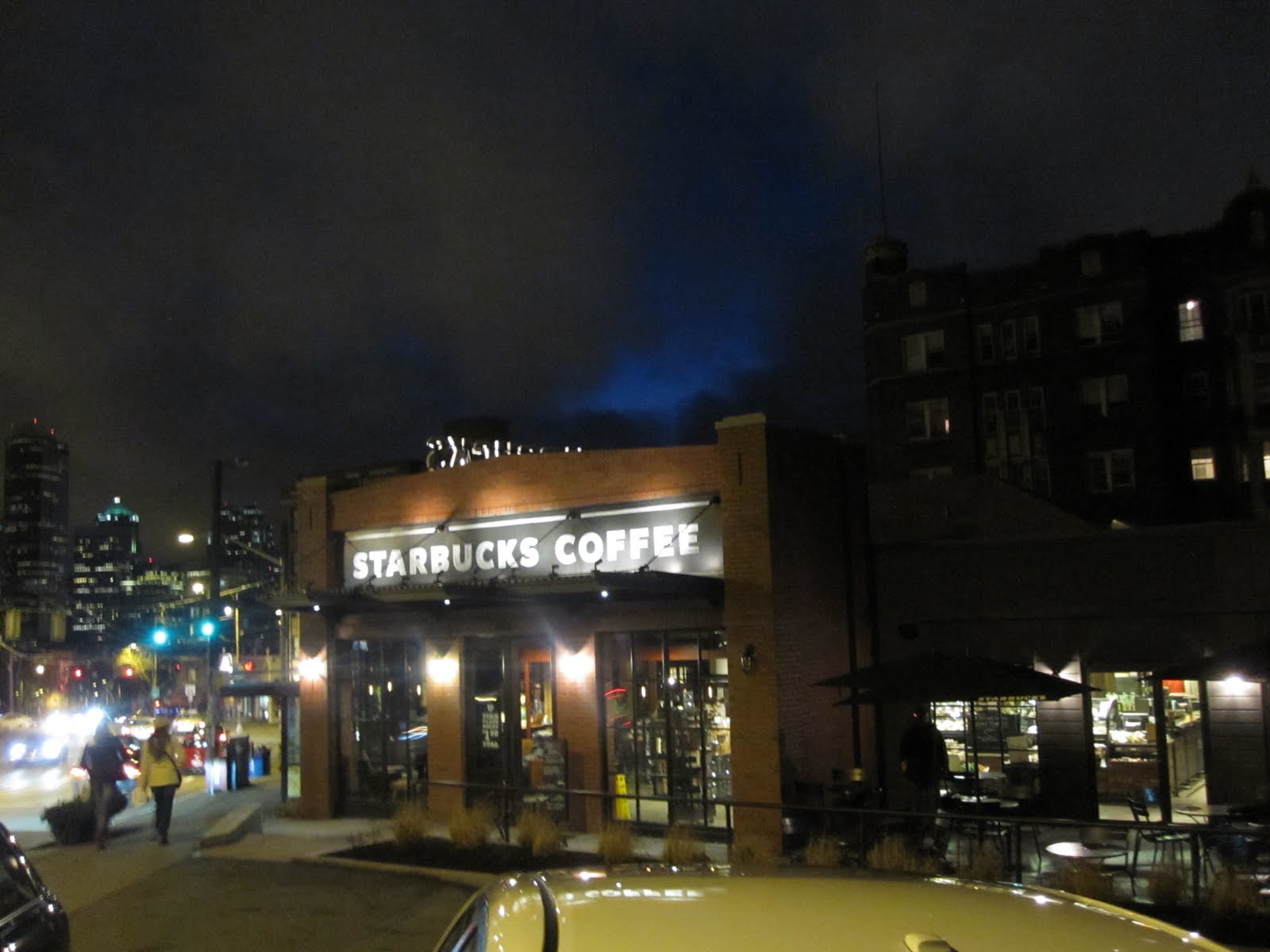

Starbucks' renaissance under Howard Schultz's direction has been relatively well documented. And, it has been a fairly significant financial success, from closing a number of underperforming stores that had sprouted like weeds to reinvesting back in the core product (coffee). But, it hasn't been without some hiccups along the way. There was a foray into value pricing, seevral attempts at reinvigorating the food offer (oatmeal seems to have finally worked) and the latest high profile logo change (better than Gap but we have some issues...).
One of the most interesting tests during this period was the un-Starbucking of an actual store, opting for a local flair in Seattle under the name 15th Avenue Coffee and Tea. Designed to invoke more of the warmth of a local coffee shop, this store attempted to market the brand incognito. While this was an obvious attempt to counter the commercialization and ubiquity of Starbucks as well as addressing the decline of "third place" status, we weren't enamored from the start. Customers can too easily see through this type of artifice. The real key is to change what Starbucks stands for (at its roots--the best coffee and the third place) rather than substitute a different name. Last week, they announced the merciful ending of the 15th Avenue experiment.
At the same time, elements of that idea are now being rolled out into next generation Starbucks prototype. The latest, in Seattle, on Olive Way, represents how that new direction can be managed under the Starbucks brand. The space is vast and open, filled with environmentally friendly touches. It was filled during our visit with people happier to gave a real third place to hang at. There are fewer barriers between barista and customer and a significantly more relaxed vibe. The menu expands to include wine and beer (intriguing to say the least) and Starbucks Reserve coffee gets heavier play.
While this store is expensive to build, takes a fair amount of real estate and would seem challenged to handle peak rushes, it certainly elevates the brand to a hip place worth hanging out at.
Stay tuned as the experience continues to evolve.
Subscribe to:
Posts (Atom)